
Car Subwoofer Not Working but Amp Has Power: 5 Best Proven Fixes
Diagnose why a car subwoofer is completely silent even though the amplifier power light is on by troubleshooting head unit sub pre-outs, voice coils, and crossover frequencies.

Turning up your favorite track expecting deep, punchy low-end only to find your car subwoofer not working but amp has power leaves your car stereo sound hollow, flat, and lifeless.
You open your vehicle’s trunk, see the amplifier’s solid blue or green power LED glowing normally, yet the subwoofer cone remains completely stationary.
In professional 12-volt car audio diagnostics, a powered amplifier driving a silent subwoofer rarely indicates that both units need complete replacement.
Common causes typically include disabled subwoofer RCA pre-out levels inside the head unit, blown internal voice coils, disconnected tinsel leads, incorrect low-pass crossover cutoffs, or high-level line output converter signal drops.
Because the amplifier’s remote turn-on line and main 12V power supply operate independently of incoming audio pre-amp signals and output voice coil circuits, an amp can power up normally while delivering zero acoustic output, directly causing a car subwoofer not working but amp has power fault.
Before unbolting the amplifier or rewiring your vehicle’s battery power run, systematic testing with a digital multimeter and head unit menu checks will pinpoint the broken signal link within minutes.
Here are five practical workshop procedures to troubleshoot why your car subwoofer not working but amp has power and restore deep, powerful bass response.
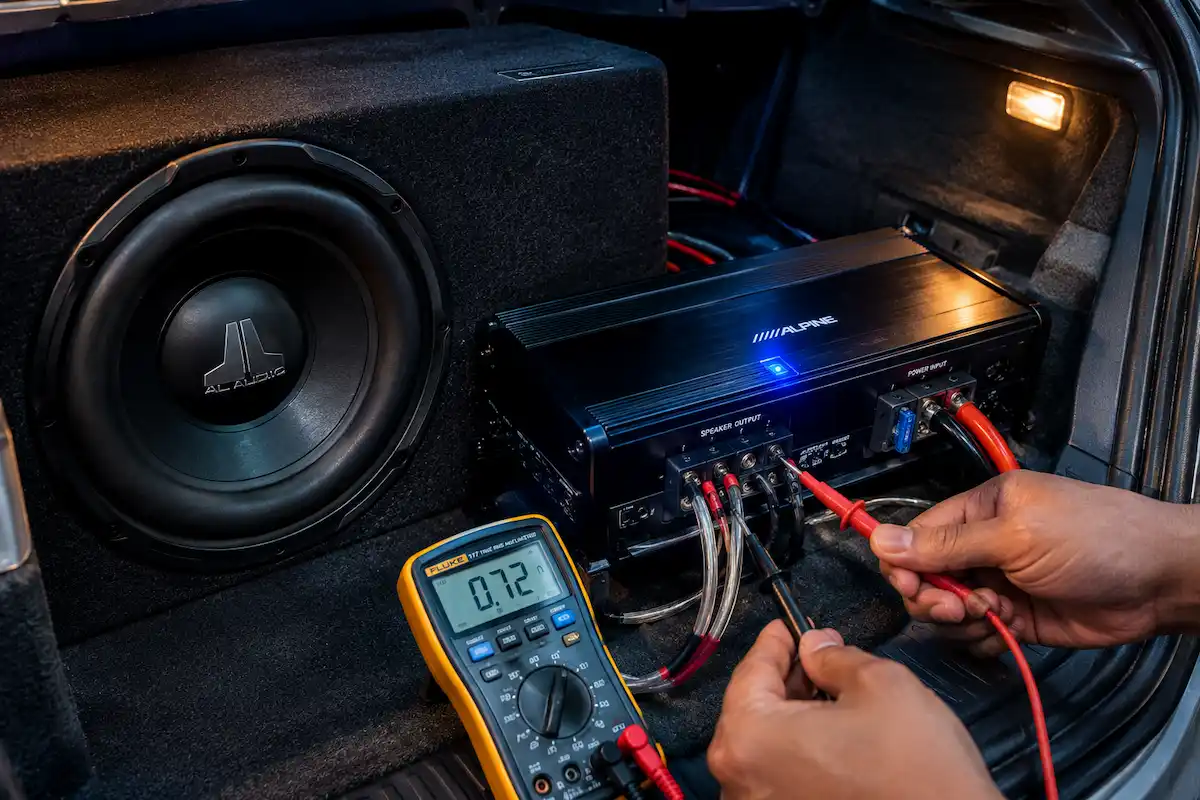
Diagnostic Matrix: Decoding Silent Powered Subwoofer Systems
Cross-reference your amplifier and enclosure symptoms against our workshop matrix whenever a car subwoofer not working but amp has power condition occurs:
| Observed Subwoofer & Amp Symptom | Underlying Electrical or Audio Cause | Immediate Workshop Action |
|---|---|---|
| Amp has solid blue power light, zero bass output | Subwoofer pre-out switched OFF in head unit audio settings menu. | Enter stereo audio settings and toggle “Subwoofer” to ON at +0dB. |
| Multimeter reads AC voltage at amp terminals, sub silent | Blown voice coil or fractured internal braided tinsel lead. | Measure resistance across speaker terminals with a DMM in ohms mode. |
| Sub pops once when ignition turns on, then stays quiet | RCA interconnect shielding shorted or line-output converter failed. | Perform 3.5mm-to-RCA phone audio test directly into amp inputs. |
| Sub works at low volume, cuts out when bass drops hard | Loose speaker terminal cups or high-resistance speaker wire gauge. | Inspect terminal cup spring posts and tighten 12–14 AWG speaker leads. |
| Amp power light on, but protect LED flashes red intermittently | Voice coil shorted below amplifier minimum rated stable impedance. | Rewire dual voice coils from parallel to series to restore rated ohms. |
Step 1: Check Head Unit Subwoofer Pre-Out and Crossover Slopes
Modern touchscreen receivers and factory infotainment screens feature dedicated internal pre-amp gates for low-frequency channels.
If the head unit’s dedicated subwoofer software switch was turned off—or if audio settings were wiped following a vehicle battery disconnect—the head unit cuts off the low-voltage RCA signal completely.
This leaves your car subwoofer not working but amp has power because the amp receives a 12V remote turn-on trigger but zero audio waveform to amplify:
- Access your car stereo’s audio configuration menu.
- Locate the setting labeled Subwoofer or Sub Out and verify it is toggled ON (some head units default to OFF or Mute).
- Ensure the Subwoofer Level is set to at least 0 dB or +2 dB rather than -24 dB or minimum attenuation.
- Inspect the Low Pass Filter (LPF). If the LPF is accidentally configured below 50 Hz, or if a high-pass filter (HPF) is engaged on the sub channel, audible bass frequencies are eliminated. Set the LPF between 80 Hz and 100 Hz.
- If your car radio also restarts unexpectedly during engine cranking, consult our guide on car stereo turns off when starting engine.
Whenever your car subwoofer not working but amp has power, verifying that the source unit is actively pushing a pre-amp signal eliminates hours of unnecessary wiring checks.
For technical reference on low-voltage pre-amp outputs and crossover slopes, review the Snap-on Diagnostic Automotive Electrical Standards.
RELATED AUDIO FIX
👉 Audio shutting off completely at higher volumes? Amplifier thermal cut diagnosis walkthrough →
Step 2: Perform the RCA Direct Input Bypass Test
RCA cables routed under car floorboards frequently suffer pinched conductors, broken center pins, or shielding shorts caused by seat rails and trim clips.
If the RCA signal path breaks between the dash and the trunk, the amplifier has no music feed to drive the sub.
You can isolate whether the issue lies in your dashboard radio or the amplifier using a simple smartphone bypass test to solve an car subwoofer not working but amp has power dilemma:
- Acquire an inexpensive 3.5mm headphone-to-dual-RCA cable (or a USB-C/Lightning to RCA adapter).
- Turn the vehicle ignition ON so the amplifier powers up (solid green/blue light).
- Unplug the existing car RCA patch cables from the amplifier’s Input jacks.
- Plug the test RCA cable directly into the amplifier’s inputs and connect the other end to your smartphone.
- Set your phone volume to 50% and play a test track with heavy bass.
- If the subwoofer comes alive and pounds with bass, your amplifier, speaker wiring, and subwoofer driver are in perfect working order. The fault lies exclusively in your head unit settings or damaged vehicle RCA cables under your carpet.
Bypassing the front-to-rear signal cable proves instantly why your car subwoofer not working but amp has power without tearing apart your dashboard.

Step 3: Measure Voice Coil DC Resistance with a Multimeter
Subwoofer voice coils handle tremendous amounts of thermal energy.
If an amplifier previously clipped or suffered a power surge, the ultra-thin copper wire winding around the voice coil former can burn through or separate, creating an open electrical circuit.
An open circuit cannot conduct current, leaving your car subwoofer not working but amp has power regardless of how high you turn the amplifier gain:
- Turn off the car ignition and disconnect both speaker wires (+ and -) directly from the subwoofer enclosure terminal cup.
- Set your digital multimeter (DMM) to measure Resistance / Ohms (Ω) on the lowest scale (200Ω).
- Touch the multimeter’s red and black probes together to verify lead resistance (it should read between 0.1Ω and 0.3Ω).
- Place the red probe on the subwoofer terminal positive (+) and black on negative (-).
- Read the display:
- Normal Reading: A standard 4-ohm sub will read roughly 3.2Ω to 3.8Ω DC resistance. A 2-ohm sub reads 1.6Ω to 1.9Ω.
- Infinite / O.L. (Open Loop): The internal voice coil is melted or burnt through. The subwoofer driver is blown and must be reconed or replaced.
- Zero / Near 0.0Ω: The voice coil has shorted internally, which will quickly force the amplifier into protect mode.
⚠️ Free-Air Push Test Precaution: With the system completely OFF, gently press down on the center of the subwoofer cone using even, flat hand pressure. If you feel gritty resistance or hear scraping sounds, the voice coil former is thermally distorted and dragging against the magnet pole piece, requiring driver replacement.
RELATED HARDWARE FIX
👉 Amplifier shutting down into red protect mode? Short circuit and thermal diagnosis guide →
Step 4: Measure AC Output Voltage at Amplifier Speaker Terminals
An amplifier’s power LED indicates that its internal power supply is receiving 12V and grounding properly.
However, the audio amplification output stage (MOSFET transistors) can fail independently, leaving the power supply alive while the output rail is dead.
Testing for alternating current (AC) voltage on the output speaker terminals proves whether the amp is actually generating amplified power when your car subwoofer not working but amp has power:
- Reattach the car’s RCA patch cables to the amplifier inputs.
- Turn the head unit volume up to approximately 70% and play a test track or a 50 Hz sine wave tone.
- Set your digital multimeter to AC Volts (V~).
- Place the meter probes directly onto the amplifier’s Speaker Output (+) and (-) terminal screws (with the sub disconnected).
- Observe the multimeter reading:
- Meter shows fluctuating AC Voltage (typically 15V to 35V AC depending on gain and wattage): The amplifier output stage is working perfectly. The issue is strictly in the speaker wire run or the subwoofer enclosure terminal cup.
- Meter stays at 0.0V AC: The amplifier is not outputting audio signal. Check input gains, verify RCA inputs, or inspect internal output stage fuses.
- For multi-channel setups with individual dead channels, check our walkthrough on fixing only one car speaker working.
Measuring raw AC output prevents replacing functioning subwoofers when an internal output rail failure is the true culprit behind your car subwoofer not working but amp has power.
RELATED SPEAKER FIX
👉 Speakers crackling, popping, or distorting under bass? Voice coil rubbing fix guide →
Step 5: Inspect Enclosure Terminal Cup and Internal Tinsel Leads
Subwoofers mounted inside sealed or ported wooden boxes undergo violent air pressure changes and intense vibrations on every heavy bass note.
Over time, the wire terminals connecting the outer terminal cup to the subwoofer’s internal frame can slip loose or snap.
Additionally, flexible braided tinsel leads connecting the terminal posts to the voice coil former can break from mechanical fatigue, directly causing a car subwoofer not working but amp has power symptom:
- Unscrew the outer terminal cup on your subwoofer box and inspect the interior spade connectors. Cheap enclosures use friction-fit spade clips that frequently vibrate loose under heavy bass.
- Unbolt the subwoofer driver from the front baffle of the enclosure.
- Inspect the braided copper tinsel leads that run from the push terminals into the spider and voice coil. Look for black burn spots, physical fraying, or snapped solder joints.
- If the enclosure wiring is broken, replace it with high-grade 12 AWG OFC (Oxygen-Free Copper) speaker wire and solder connections securely to avoid future vibration-induced dropouts.
- If your head unit’s clock and audio settings keep clearing every time you turn the key, review our guide on fixing car stereo time and settings reset.
Troubleshooting a stubborn car subwoofer not working but amp has power issue comes down to verifying the complete signal chain from head unit pre-out to voice coil windings.
Enabling head unit subwoofer channels, performing an RCA phone bypass test, reading DC resistance across voice coils, measuring AC output voltage at amplifier speaker terminals, and checking internal enclosure terminal spade clips will systematically restore your deep car audio bass.
Follow these workshop steps whenever your amp glows green or blue while leaving your sub silent, ensuring you eliminate any car subwoofer not working but amp has power errors permanently.
Frequently Asked Questions (FAQ)
Why does my car subwoofer not working but amp has power light on?
A car subwoofer not working but amp has power issue is usually caused by a turned-off subwoofer pre-out setting inside the head unit, damaged RCA interconnect cables, disconnected enclosure terminals, or a blown subwoofer voice coil.
How can I test if my amplifier is sending power to the subwoofer?
Set a digital multimeter to AC Voltage (V~), play music with heavy bass at moderate volume, and place the meter probes on the amplifier’s speaker output terminals. If the meter displays fluctuating AC voltage (typically 15V–30V), the amplifier is outputting power properly.
How do I know if my subwoofer is blown or if the amp is bad?
Disconnect the subwoofer and measure resistance across its speaker terminals using a multimeter set to Ohms (Ω). If it reads normal resistance (around 2Ω or 4Ω), the subwoofer is healthy and the issue lies in the amplifier output or incoming RCA audio signal. If the meter displays Open Loop (O.L.), the subwoofer voice coil is burnt out.