
Why Only One Car Speaker Works (5 Bench-Tested Audio Fixes)
If sound is only coming from a single corner of your car while the other three speakers stay dead silent, don't rush to buy a new head unit. Here is how to isolate the exact wiring break, blown voice coil, or balance setting responsible.

Few dashboard headaches are as instantly annoying as getting into your driver’s seat, turning up your favorite track, and realizing only one car speaker works while the rest of the cabin stays dead silent. Your first instinct might be that three speakers blew up at the exact same second, or that your expensive touchscreen is completely fried.
In our workshop experience, three speakers almost never blow out together out of nowhere. Car stereos run four separate speaker channels using dedicated wire pairs for each corner of the vehicle. Because these channels are split up, a single working speaker usually comes down to an accidental balance slide on your touchscreen, a cracked wire in the door hinge, or an internal amplifier safety trip.
Before you start pulling door panels off or shopping for an expensive replacement deck, fifteen minutes of basic bench testing will pinpoint the exact fault. Here are five practical workshop checks to fix audio dropouts and get clean, balanced sound back across your entire cabin.
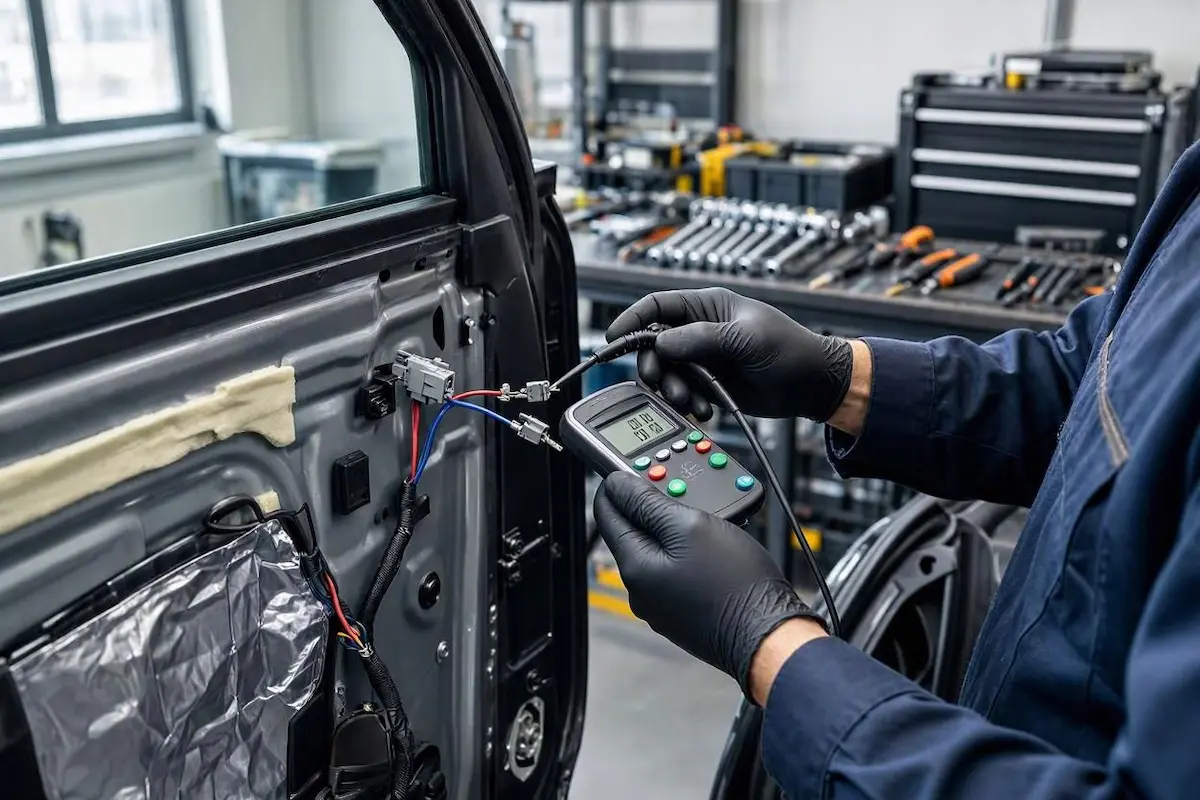
Diagnostic Matrix: Why Only One Car Speaker Works
Match your vehicle’s exact symptoms against our workshop failure matrix to narrow down why only one car speaker works before unhooking any dashboard wires:
| Speaker Output Symptom | Most Likely Technical Cause | Immediate Workshop Action |
|---|---|---|
| Sound plays from one corner; all other speakers silent | Balance and Fader sliders shifted completely off-center in software. | Open stereo DSP audio settings and tap “Center / Reset” on the crosshair grid. |
| Dead speakers crackle or cut back in when swinging doors open | Work-hardened copper conductor snapped inside the rubber door jamb boot. | Firmly squeeze and wiggle the door flex conduit while playing music. |
| Working speaker sounds clear; silent speakers make zero hiss | Internal amplifier IC channel failure or burned PCB output trace. | Execute a 16-pin harness channel-swap test behind the stereo chassis. |
| Door woofers play, but high-frequency tweeters remain dead | Loose screw terminal clamp on passive crossover block or blown capacitor. | Inspect resistance directly across passive crossover input and output terminals. |
| Only one side works on Bluetooth, but all work on FM radio | Phone accessibility balance shifted off-center, or mono audio forced. | Recenter phone audio balance in accessibility menus and rebuild Bluetooth profile. |
Step 1: Center Balance, Fader, and Smartphone Accessibility Sliders
Whenever you notice that only one car speaker works, the first rule of the shop is simple: always check your digital audio routing before touching a screwdriver.
Modern touchscreens and digital sound processor (DSP) screens make it surprisingly easy to drag the listening position into an extreme corner by accident while tapping navigation maps or swiping down notification menus.
Audit these three software configurations before loosening a single screw:
- Head Unit Balance & Fader: Open the sound equalizer app on your stereo and head straight to the Balance and Fader tab. Confirm that the crosshair sits dead center at coordinates (0, 0). If the dot is pinned against a single corner, tap the “Reset” or “Center” button to level all four channels.
- Cabin Position & Time Alignment Presets: Many Android decks and factory sound systems feature listening presets like “Driver Focus” or “VIP.” When these profiles glitch, they cut power to passenger and rear speakers so heavily that those corners seem broken. Switch time alignment back to “All Cabin” or “Bypass.”
- Phone Accessibility Audio Balance: If all speakers play normally on FM radio but only a single door works when streaming Spotify over Bluetooth or CarPlay, your phone is the culprit. On an iPhone, go to Settings > Accessibility > Audio & Visual and ensure the Balance slider sits dead center. On Android, open Settings > Accessibility > Hearing Enhancements, center the Connected Audio Balance slider, and turn off Mono Audio.
Fixing these balance sliders clears up a high percentage of calls we get where drivers assume their equipment is blown when it is purely a software offset.
RELATED TROUBLESHOOTING GUIDE
Step 2: Run a 16-Pin Harness Channel-Swap Test at the Stereo
Before you tear door cards off assuming that only one car speaker works due to blown hardware, perform a channel-swap test directly at the back of the stereo harness.
This quick wiring test tells you immediately whether the radio’s built-in amplifier failed, or if the problem sits further down the line in the car’s physical wiring.
Most stereos follow standard ISO 10487 wiring color codes, making speaker leads easy to spot:
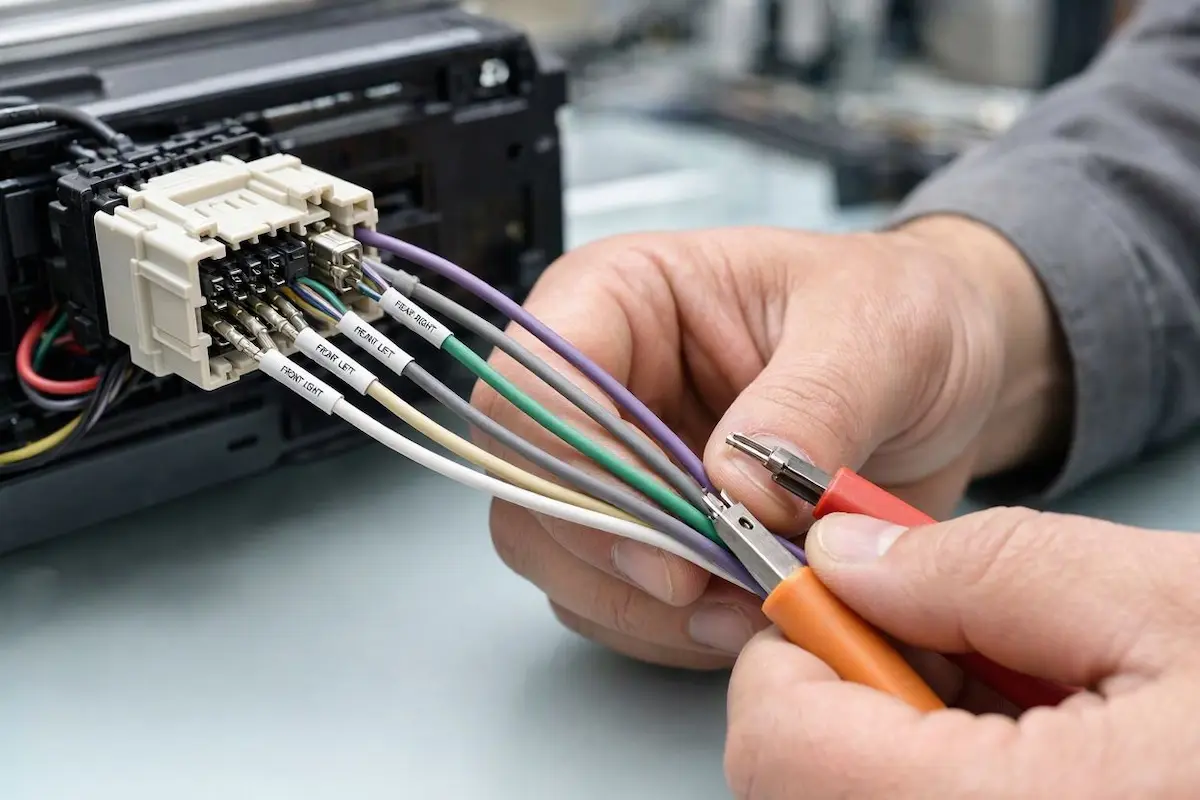
- Pull the radio chassis out of the dashboard sleeve so you can reach the main 16-pin connector.
- Locate the eight speaker wires arranged in solid and striped color pairs:
- White & White/Black: Front Left (+ and -)
- Gray & Gray/Black: Front Right (+ and -)
- Green & Green/Black: Rear Left (+ and -)
- Purple & Purple/Black: Rear Right (+ and -)
- Find the wire pair that feeds your single working speaker (for example, the White Front Left pair).
- Using short jumper wires or bullet connectors, plug that known good channel directly into the harness leads of one of your silent speakers (like the Gray Front Right door pair).
- Turn the stereo on and play music at a low, clean volume.
If that silent speaker suddenly plays clean audio, the door speaker and car wiring are totally fine; the issue is an internal blown amplifier channel on the stereo board.
If the silent speaker stays dead even on the good audio channel, the problem is inside that door’s wiring or the speaker itself. Review our wiring pinout guide to connect factory wiring to android head unit plugs if any pins look loose or damaged.
Catching a bad radio output early saves hours of chasing wiring gremlins when tracking down audio faults.
Step 3: Inspect the Rubber Door Jamb Hinge Boots for Snapped Wires
When physical wiring snaps in a car, it almost never breaks behind the dashboard or under the floor carpet. The break almost always happens right inside the black rubber accordion boot between the car body and the door frame.
Every single time a car door opens and shuts, that bundle of copper wire bends back and forth. After five to ten years of daily driving, the copper strands work-harden, crack, and eventually snap clean in two.
This hidden break is one of the most common mechanical reasons why only one car speaker works in older vehicles:
- The Wiggle Test: Turn on your stereo, pick a song with steady vocals, and set the volume to around 30%. Walk over to each dead door, open it wide, and find the thick rubber accordion boot running into the door frame.
- Squeeze, bend, and gently wiggle the rubber boot with your fingers while listening closely to the dead speaker.
- If the speaker crackles, pops, or suddenly springs back to life while you flex the rubber sleeve, the copper core inside is broken.
- How to Repair It Properly: Pop the rubber grommets out from the steel pillars to access the wire harness inside. Strip back the factory wrapping to find the broken leads. Never just twist the broken ends together with electrical tape; door movement will pull a twist splice apart in a matter of weeks.
- Solder in a short section of high-strand, flexible automotive wire to bridge the flex zone, and seal the repair using marine-grade adhesive heat shrink tubing.
Fixing snapped door wires permanently ends that annoying issue where audio cuts out every time someone slams a door.
RELATED TROUBLESHOOTING GUIDE
Step 4: Test the Silent Speakers with a Multimeter and Battery
If audio signal leaves the stereo and the door wires are unbroken, it is time to check the physical loudspeaker driver itself. Playing music at clipping volume or dealing with rainwater leaks inside door cavities can cook voice coils or corrode delicate tinsel leads.
This damage leaves an open electrical circuit where only one car speaker works simply because the others have burned-out voice coils. Take off the door card and run these two quick bench tests right at the speaker terminals:
- Multimeter DC Resistance Test: Unplug the two-pin wiring plug from the speaker basket. Set your multimeter to the lowest resistance setting (200Ω). Firmly place the red and black probes on the bare positive and negative terminal tabs of the speaker.
- Good Reading: A standard 4-ohm car speaker should show between 3.2Ω and 3.9Ω DC resistance. If you have factory premium speakers (like Bose or JBL), they often read between 1.6Ω and 2.1Ω.
- Blown Reading: If the meter shows “O.L.” (Open Loop) or infinite resistance, the thin voice coil wire has melted and snapped. The speaker is dead and needs to be replaced.
- The 9V Battery “Pop” Test: If you do not have a multimeter on hand, grab a regular 1.5V AA battery or a 9V battery. Touch two short scrap wires to the battery poles and tap them quickly against the speaker terminals. A working speaker will make a clear, hollow “thump” as the cone moves. If the cone does not budge and stays completely silent, the voice coil is burned out.
⚠️ Voice Coil Safety Rule: When running the battery pop test, only brush the wires against the terminals for a fraction of a second. Never hold continuous battery power on a speaker terminal, or you can overheat the voice coil and warp the former.
Swapping out open-circuit speakers gets your soundstage back and resolves dead audio channels for good.
AMPLIFIER FAULT PREVENTION
Step 5: Check External Amp RCA Leads and Crossover Blocks
If your car audio build runs aftermarket multi-channel amplifiers or component speaker sets, the problem can hide in your auxiliary gear.
In custom sound setups, finding that only one car speaker works often traces back to a backed-out RCA plug or a loose crossover screw terminal. Work through these hardware checks on your aftermarket amp rack:
- Swap RCA Inputs at the Amp: At the amplifier input panel, swap the Front Left and Front Right RCA jacks. If the working sound jumps to the opposite side of the vehicle, your amplifier is healthy; the problem is a damaged RCA cable or a bad pre-out jack on the head unit.
- Inspect Component Crossover Blocks: Component systems split audio using plastic crossover boxes hidden behind the dash or inside door cavities. Road vibration regularly shakes terminal screws loose. Make sure the input and output wires have not pulled out of their clamps.
- Check for Frayed Wire Strands: Look closely at the amplifier’s speaker output terminals. A single stray hair of copper wire bridging across adjacent terminals will trip the amp’s protection circuit, cutting off channels and leaving an installation with dead audio channels under load. If your deck shuts off entirely when you turn up the gain, read our guide on how to fix a car stereo that turns off when volume is high.
Tightening down loose crossover terminals guarantees that channel dropouts are resolved without buying unneeded replacement gear.
Sorting out why only one car speaker works comes down to tracking the audio path step by step instead of guessing. Centering your DSP balance sliders, running a harness channel swap behind the deck, and checking voice coils with a multimeter will isolate the fault every single time.
Follow these practical workshop steps to track down the culprit, fix the circuit, and enjoy full, punchy stereo sound on your next drive.
Frequently Asked Questions (FAQ)
What should I check first when only one car speaker works?
When only one car speaker works, always start with the Balance and Fader settings in your stereo’s audio menu to verify the sound has not been shifted into an extreme corner. After that, check your smartphone’s Accessibility settings to make sure Left/Right balance is centered and mono audio is turned off.
Can a blown fuse cause only one car speaker to stop working?
No. Car stereos and factory amplifiers use shared 12V constant and accessory power fuses. If a radio fuse blows, the entire head unit goes completely dark. Individual speaker channels are never fused separately; each speaker runs on its own copper audio circuit directly from the amplifier chip.
How can I tell if the problem is my car stereo or the speaker itself?
Run a channel-swap test at the rear 16-pin harness. Hook the wires of your single working channel to the wiring of a dead speaker. If the quiet speaker starts playing music, the speaker is fine and the stereo’s internal amp channel has failed. If it stays silent, the fault is in your door wiring or the speaker voice coil.
Why does only one speaker play music when using Bluetooth?
If every speaker plays cleanly on FM radio but only one works over Bluetooth, the problem is software on your phone. Go into your smartphone Accessibility settings, make sure the audio balance slider is centered, turn off Mono Audio, and unpair and reconnect your Bluetooth connection on both devices.