
Car Stereo Turns Off When Starting Engine: 5 Best Proven Ways to Fix Cranking Reboots
Fix car stereo turning off when starting the engine by isolating starter motor voltage drops, configuring ACC ignition relays, and testing battery ground resistance.

Turning the ignition key only to watch your car stereo turns off when starting engine forces you to endure annoying 30-second cold reboot delays every time you crank the vehicle.
The screen shuts down completely while the starter motor turns over, resetting your Apple CarPlay navigation or dropping active Bluetooth phone calls.
In professional 12-volt car audio workshop diagnostics, an unexpected shutdown during cranking rarely means the head unit processor is defective.
Common causes typically include normal ignition switch accessory power cuts, severe starter motor voltage sags below 10.5 volts, high-resistance battery ground straps, or swapped constant and switched power wires.
When the vehicle starter engages, huge electrical current demands pull system voltage down, directly causing a car stereo turns off when starting engine lockout on sensitive aftermarket stereos.
Before replacing your radio or buying unnecessary electrical components, methodical bench isolation will pinpoint the exact voltage drop in under ten minutes.
Here are five practical workshop procedures to troubleshoot why your car stereo turns off when starting engine and restore stable power during vehicle startup.

Diagnostic Matrix: Why Car Stereos Reboot During Cranking
Cross-reference your infotainment system’s behavior against our workshop matrix whenever a car stereo turns off when starting engine condition disrupts your cabin electronics:
| Observed Cranking Behavior | Underlying Electrical or Wiring Cause | Immediate Workshop Action |
|---|---|---|
| Screen goes black during crank, reboots to logo afterward | Vehicle ignition switch intentionally cuts ACC circuit to prioritize starter. | Install a 12V time-delay capacitor buffer relay on the red ACC line. |
| Stereo loses clock time and radio presets on every start | Constant +12V (Yellow) and Switched ACC (Red) wires swapped in harness. | Verify permanent 12V battery feed pin with a digital multimeter. |
| Unit shuts off and engine cranks sluggishly or slowly | Vehicle battery capacity degraded, causing severe voltage dip below 9.5V. | Perform a carbon-pile load test on the 12V vehicle battery. |
| Display flickers erratically when key hits the crank position | High electrical resistance or loose fastener on main chassis ground strap. | Clean paint and corrosion off the dashboard negative ground terminal. |
| Screen stays off permanently until key is turned off and on | Aftermarket CAN Bus decoder box dropping ignition wake-up state packet. | Update CAN decoder profile settings inside the stereo factory menu. |
Step 1: Test Cranking Battery Voltage Sag with a Multimeter
The vehicle starter motor draws anywhere from 100 to 250 amps of instantaneous current to rotate the engine flywheel.
A resting battery measuring 12.6 volts can easily dip under heavy mechanical load. If terminal voltage drops below 10.0 volts, the stereo’s internal power management IC shuts down to protect its microprocessor.
This electrical starvation is a primary mechanical cause of a car stereo turns off when starting engine complaint on older batteries:
- Set your digital multimeter selector to DC Voltage (20V scale).
- Place the meter probes firmly across the positive (+) and negative (-) battery terminals under the hood.
- Have an assistant crank the engine while you closely observe the multimeter display screen.
- Interpreting Cranking Voltage: A healthy automotive battery should remain above 10.2 volts during active cranking. If voltage plunges below 9.5 volts, the battery has lost cold-cranking capacity and requires professional carbon-pile load testing.
- Clean any white sulfate corrosion from battery posts using a wire terminal brush to eliminate parasitic resistance.
For technical reference on automotive electrical testing specifications, review the SAE Battery Cranking Load Test Standards.
RELATED ELECTRICAL FIX
👉 Experiencing overnight power drains after installing your stereo? Workshop sleep current guide →
Step 2: Differentiate Factory Ignition Load Shedding from Faults
In many modern vehicles, a brief stereo shutdown during engine cranking is not a defect; it is a factory design feature known as “load shedding.”
Automakers design ignition barrel switch contacts to disconnect the Accessory (ACC) rail mechanically while the key is held in the “Start” position.
Understanding this distinction prevents replacing functional head unit hardware unnecessarily when your car stereo turns off when starting engine:
- Factory Radios vs. Android Screens: Simple factory radios restart in 1 second, making the cut barely noticeable. Android head units, however, drop into a 30-second cold boot loop unless continuous sleep power is maintained.
- Check Saved Memory: If your radio restarts but preserves clock time, paired Bluetooth devices, and equalizer presets, your constant 12V memory feed is functioning correctly.
- If the stereo returns to normal operation immediately once the engine catches and idles, the shutdown is driven purely by the factory ACC drop.
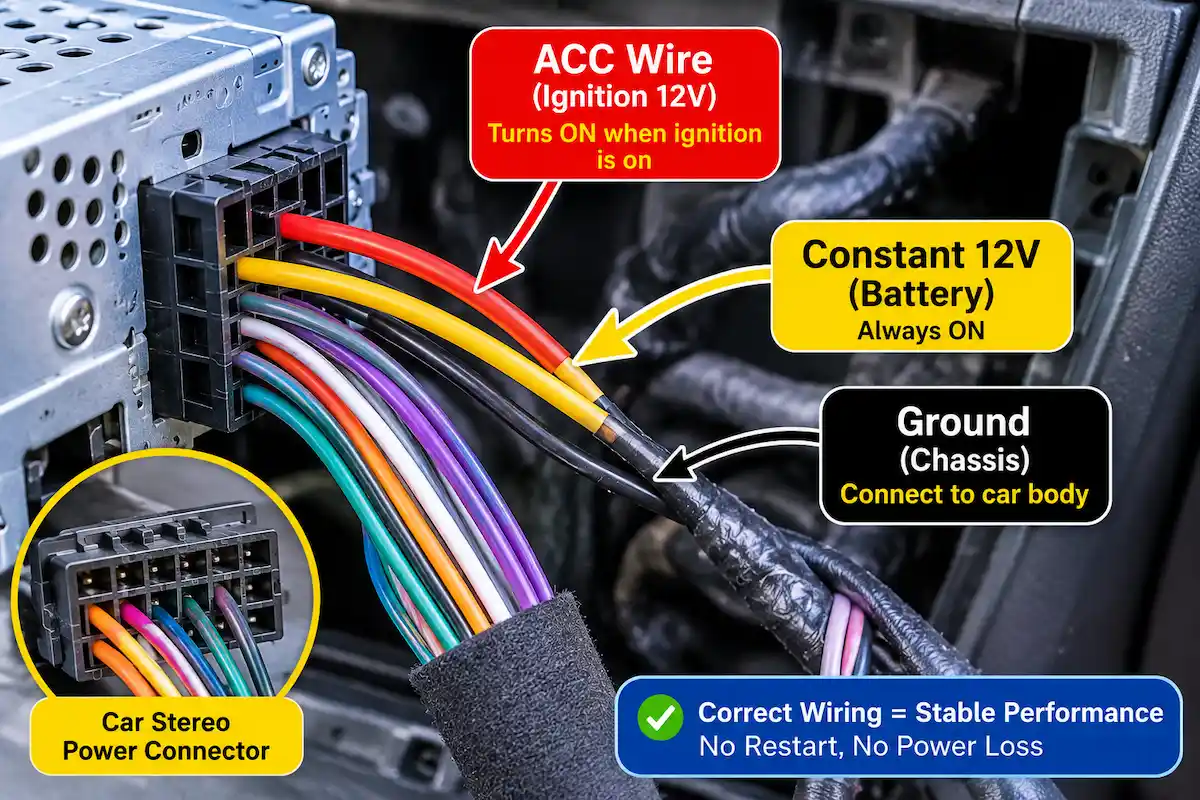
Step 3: Verify Constant 12V (Yellow) and Switched ACC (Red) Wires
Aftermarket stereos rely on two separate 12-volt circuits to maintain operating states.
The Yellow wire requires uninterrupted +12V battery current, while the Red wire receives switched ignition signal voltage.
If an aftermarket wiring harness adapter inadvertently swaps these leads, the head unit memory partition collapses on crank, causing a car stereo turns off when starting engine lockout:
- Unmount the car stereo trim to expose the rear wiring harness. Review our workshop guide on connecting factory wiring harnesses to Android units.
- Back-probe the terminal pin of the Yellow wire with your digital multimeter set to DC volts.
- Turn the ignition completely OFF; the yellow wire must still read a solid +12V to +12.6V. If it drops to 0V, memory power is wired incorrectly.
- Back-probe the Red wire; it should read 0V with the key removed and jump to +12V when switched to the ACC position.
- If wire assignments are reversed, unpin the terminal connectors from the adapter block and seat them into their proper positions according to the manufacturer schematic.
⚠️ Direct Battery Bridging Precaution: Never twist the yellow constant wire and red ACC wire together and connect them permanently to an unswitched battery feed to prevent cranking reboots. Bypassing the ignition switch keeps internal amplifier boards active, draining your vehicle battery overnight.
RELATED AUDIO FIX
👉 Audio dropping out when turning the volume up? Complete amplifier and speaker fix guide →
Step 4: Install a 12V Time-Delay Power Buffer Relay
If your vehicle ignition mechanically cuts the ACC circuit or voltage dips slightly during crank, an inline power buffer provides an effective engineering solution.
A compact 12V time-delay relay or car audio capacitor buffer holds the ACC trigger line high for 3 to 5 seconds during the cranking window.
This bridging keeps the radio micro-controller alive without modifying vehicle factory ignition switches when your car stereo turns off when starting engine:
- Acquire a dedicated 12V automotive time-delay turn-off relay (or a head unit power stabilizer module).
- Connect the module’s primary power input terminal to the fused Constant 12V (Yellow) line behind the radio.
- Connect the vehicle-side ACC lead to the module’s trigger sensor terminal.
- Route the module’s timed output line directly to the red ACC input lead of your car stereo.
- Adjust the delay potentiometer to 3 seconds; when the key turns to start, stored capacitor energy maintains 12V on the ACC pin until the engine idles.
RELATED PROTOCOL GUIDE
👉 Setting up an aftermarket CAN Bus box? Complete protocol configuration walkthrough →
Step 5: Inspect Ground Terminals for Cranking Voltage Drop
A ground path that appears perfectly clean during resting conditions can fail under the massive return current of engine cranking.
If the radio’s ground wire shares a chassis bolt with corroded metal or loose factory fasteners, ground potential rises above zero volts during startup.
This ground float deprives the head unit of operating current, producing a car stereo turns off when starting engine symptom:
- Unmount the radio and inspect the black ground wire connection point behind the dash.
- Set your multimeter to DC volts, touching one test probe to the stereo’s black ground wire and the other to the negative battery terminal under the hood.
- Crank the engine; voltage drop across the ground circuit should measure less than 0.2 volts.
- If the meter measures higher resistance or significant voltage, relocate the stereo ground lead directly to solid, unpainted vehicle body sheet metal using a star washer and self-tapping screw.
- If your stereo screen exhibits continuous cycling afterward, consult our walkthrough on Android car stereo boot loops to resolve system firmware crashes.
Diagnosing an unexpected car stereo turns off when starting engine issue comes down to isolating mechanical ignition load shedding from true electrical voltage drops.
Testing battery cranking health under load, confirming proper constant memory pinouts, securing clean chassis ground connections, and adding an ACC delay buffer eliminates unwanted reboots systematically.
Follow these workshop steps whenever a car stereo turns off when starting engine fault disrupts your driving navigation.
Frequently Asked Questions (FAQ)
Why does my car stereo turns off when starting engine?
A car stereo turns off when starting engine either because the vehicle ignition switch is engineered to disconnect the accessory (ACC) circuit during cranking, or because the starter motor pulls battery voltage below the radio’s 10V operating limit.
Is it normal for a car radio to turn off while cranking?
Yes, many vehicle manufacturers intentionally cut power to non-essential accessories (like the radio and wipers) during cranking to dedicate maximum electrical amperage to the starter motor.
How do I stop my Android head unit from rebooting when starting the car?
You can prevent Android head units from rebooting by installing an inline 12V time-delay relay or power buffer capacitor on the red ACC wire, which maintains power for 3 seconds while the starter turns over.