
Engine Whine in Car Stereo? 5 Proven Fixes for Alternator Whistle
High-pitched whistling pitch rising with engine RPM? Learn how to eliminate engine whine in car stereo speakers using ground loop isolators, RCA routing, and chassis grounds.

You turn on your engine, put your foot down on the gas pedal, and hear an annoying high-pitched whistling noise coming through your speakers that rises and falls with engine RPM. Dealing with engine whine in car stereo setups is an incredibly common headache after installing an aftermarket head unit, amplifier, or powered subwoofer.
That irritating pitch isn’t a blown speaker or bad music files; it is electrical interference radiating from your car’s charging system. When your alternator charges the battery, it generates alternating current (AC) that gets converted to direct current (DC). If electrical grounding is uneven, tiny voltage ripples bleed straight into your audio signal path. Here are 5 workshop-tested steps to kill engine noise permanently.
Why Does Engine Whine in Car Stereo Systems Happen?
In 95% of car audio installations, unwanted buzzing and whistling stems from an electrical condition known as a ground loop. A ground loop occurs when two audio components connected together—such as your Android head unit and an external amplifier—are grounded at different points with unequal electrical resistance.
Because electricity always seeks the path of least resistance, stray voltage from the vehicle chassis travels backward through the outer shield of your RCA cables to equalize. If you also notice audio cutouts or dropouts, verify your speaker wiring before testing, or consult our guide on fixing android car stereo no sound issues.

| Audio Noise Symptom | Likely Root Cause | Immediate Workshop Fix |
|---|---|---|
| High-pitched whistle changes with accelerator RPM | Alternator AC ripple leaking via RCA ground | Install a Ground Loop Isolator (GLI) or reground unit |
| Constant low-frequency humming or buzzing | Loose head unit chassis ground | Bolt black ground wire directly to bare dashboard metal |
| Popping sound when tapping car brakes or blinkers | Audio cables routed parallel to factory wiring loom | Separate RCA patch cables from 12V power harnesses |
| Whine stops when unplugging RCA cables from amp | Noise entering before amplifier stage | Ground the RCA outer shields to head unit metal chassis |
1. Separate RCA Audio Cables from 12V Power Lines
The quickest installation mistake that introduces engine whine in car stereo lines is running your low-level RCA patch cables alongside heavy 12V power wiring.
- If you installed an under-seat amplifier or boot subwoofer, never bundle the RCA cables with the thick blue/red 12V battery power wire along the same car door sill.
- The massive pulsating current traveling to your amplifier generates an electromagnetic field that leaches directly into unshielded audio interconnects.
- The correct routing rule: Always run the heavy 12V power cable down the driver-side door sill, and route your RCA cables and speaker lines down the passenger-side sill. If cables must cross, cross them strictly at a 90-degree right angle.
2. Ground the Head Unit to Clean Bare Metal
Most aftermarket stereo harness adapters splice your head unit’s black ground wire back into the factory harness ground pin. In older vehicles, that factory grounding circuit travels through thin dashboard wires shared with instrument clusters and HVAC blowers, picking up heavy electrical noise.
To eliminate alternator whine caused by dirty factory grounds:
- Snip the black ground wire coming from the 16-pin stereo harness (leaving the car-side factory pin capped).
- Extend the stereo’s ground wire with 14-gauge copper wire, crimp a solid ring terminal to the end, and bolt it directly into an unpainted, bare metal steel support beam behind the dashboard.
- Scrape away any paint, rust, or factory primer with sandpaper before bolting down the ring terminal to guarantee zero-ohm resistance.
3. Ground the RCA Outer Shield (The Workshop Wire-Wrap Trick)
Generic Chinese Android stereos (TS10, Allwinner T5, MTK 8227L) frequently suffer from weak or ungrounded internal RCA output jacks. When the internal circuit board’s trace fuse blows from a minor short, the RCA ground shield begins floating, creating an instant engine whine in car stereo hum.
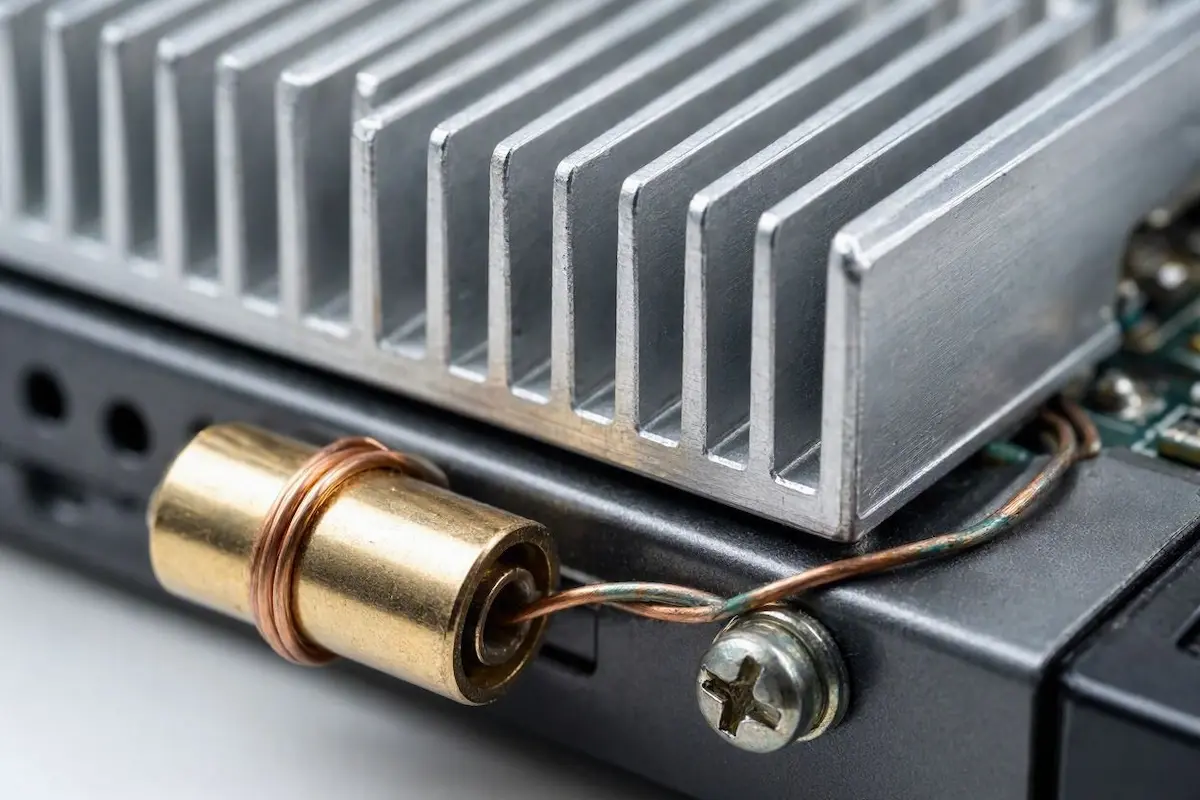
You can verify and cure this in two minutes using a piece of scrap wire:
- Strip 1 inch of insulation off a short piece of thin copper wire.
- Wrap the bare copper tightly around the outer metal ring (the collar shield) of your RCA plug behind the stereo.
- Secure the other end of that wire under one of the small metal screws on the head unit’s aluminum rear heatsink.
- If the whistling stops immediately when you touch the wire to the chassis casing, your head unit has a blown internal RCA trace, and this external chassis bypass fixes it permanently.
4. Install an In-Line Ground Loop Isolator (GLI)
If your head unit and external amplifier are grounded solidly but differing chassis potential still produces stubborn engine whine in car stereo speakers, an in-line passive Ground Loop Isolator is the cleanest fix.
- A Ground Loop Isolator uses internal 1:1 audio isolation transformers to pass audio frequencies magnetically while physically blocking the direct DC current path between the two components.
- Unplug your RCA cables from the rear of the stereo, plug the isolator into the stereo’s front/rear pre-outs, and plug your amp interconnects into the isolator’s female ends.
- Place the isolator as close to the amplifier’s input stage as possible for the quietest noise floor.
5. Retune Amplifier Gain Settings Correctly
Many drivers mistakenly treat their external amplifier’s “Gain” or “Input Sensitivity” dial as an extra volume control, cranking it all the way to maximum. Setting the gain too high forces the amplifier to boost minute background electrical noise, resulting in severe engine whine in car stereo systems even at low listening volumes.
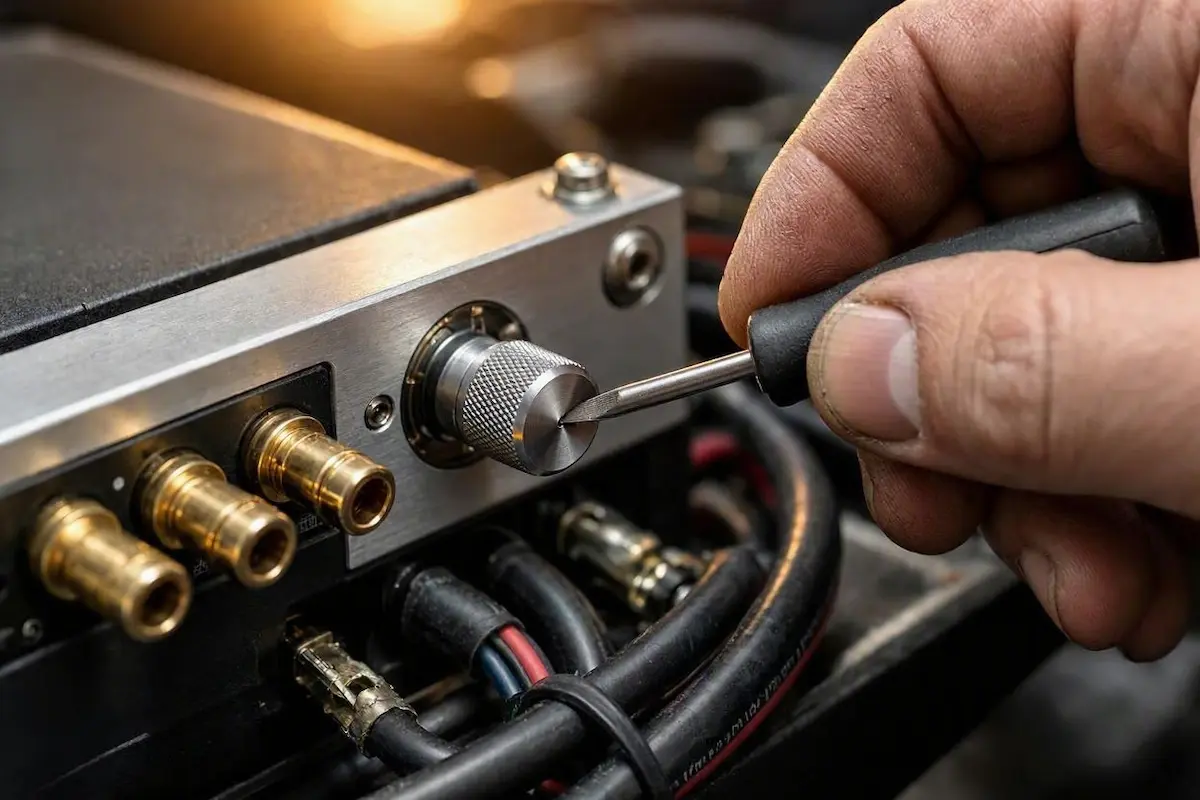
- Turn the amplifier gain knob all the way counterclockwise to its minimum level.
- Turn your Android car stereo’s volume up to roughly 75% to 80% (clean master signal before digital clipping).
- Play a dynamic, well-mastered audio track.
- Slowly turn the amplifier gain knob clockwise until the volume is loud and full, stopping the moment you hear the slightest hint of distortion.
- Proper gain matching keeps the audio signal well above the electrical noise floor, silencing background hums. If your car battery is aging or drains rapidly while the engine is off, consult our guide to troubleshoot car stereo battery drain.
Frequently Asked Questions (FAQ)
Does engine whine in car stereo mean my alternator is about to die?
Not necessarily. While a blown alternator diode can emit heavy AC ripple voltage into your car’s wiring, 90% of whine issues stem from ground loops or parallel RCA cable routing rather than a failing alternator charging unit.
Why does engine whine in car stereo increase when I turn on headlights or AC?
Heavy electrical accessories like headlights, radiator fans, and AC blower motors pull large amounts of current through the chassis ground. If your stereo or amp ground point is shared or loose, this increased current draw deepens the ground voltage differential, amplifying the whine.
Will adding a large car audio capacitor fix engine whine in car stereo speakers?
No. Stiffening capacitors are designed to support sudden bass drops during high subwoofer amplifier demand; they do not filter out high-frequency alternator ground loop frequencies. Focus on solid ground points and RCA isolation instead.