
Car Speakers Crackle When Bass Hits: 5 Best Proven Workshop Fixes
Eliminate crackling, popping, and mechanical distortion in car door speakers during heavy bass drops by calibrating high-pass crossover filters, amp gain clipping, and damaged foam surrounds.

Cranking up your favorite hip-hop or electronic track only to hear your car speakers crackle when bass hits turns an enjoyable drive into an ear-piercing mess of static and mechanical slapping.
Vocals and treble notes sound crisp at moderate levels, yet the exact millisecond a deep kick drum or sub-bass drop strikes, the door panels buzz, pop, and rattle aggressively.
In professional 12-volt car audio diagnostics, low-frequency distortion rarely means you need to rip out your entire sound system or replace your head unit.
Common causes typically include un-filtered sub-bass frequencies over-extending small 6.5-inch door drivers, amplifier gain clipping sending square-wave DC spikes, dry-rotted rubber speaker surrounds, or loose vapor barriers vibrating inside the door cavity.
Because standard door mid-bass drivers are physically incapable of reproducing frequencies below 60 Hz at high volume without exceeding their mechanical Xmax excursion limits, feeding them full-range bass signals immediately causes your car speakers crackle when bass hits.
Before ordering expensive aftermarket component speakers, systematic calibration of your head unit’s high-pass crossovers and amplifier gain structure will restore clean, punchy audio.
Here are five practical workshop procedures to troubleshoot why your car speakers crackle when bass hits and eliminate low-end distortion permanently.
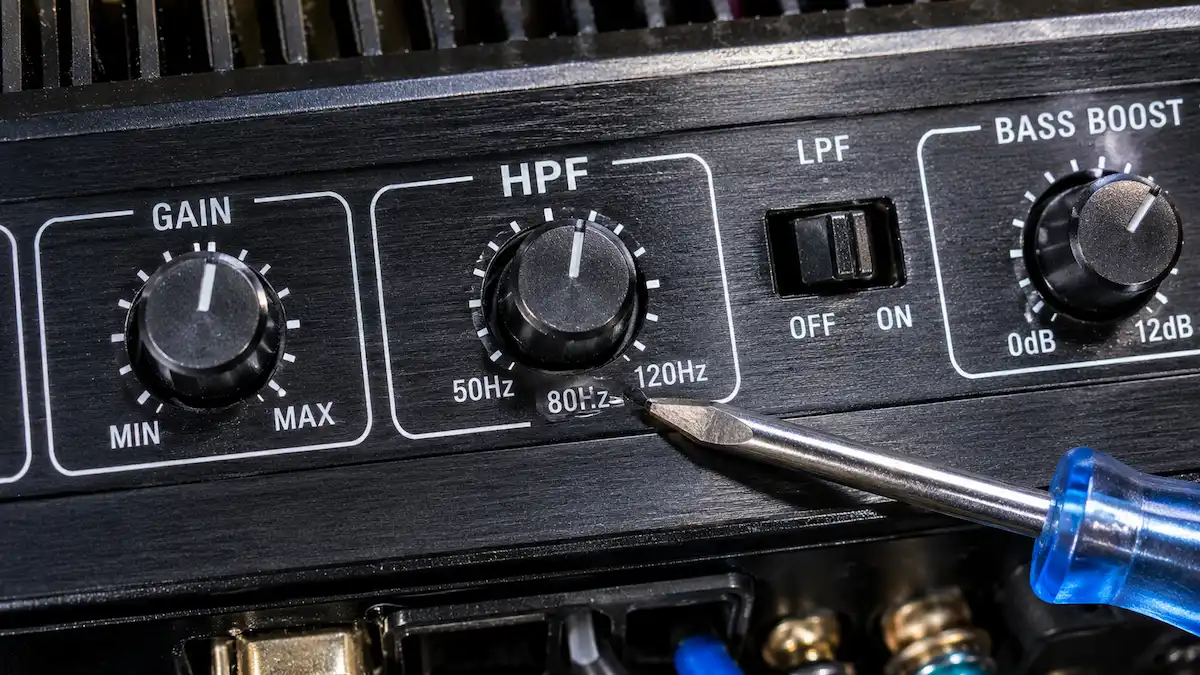
Diagnostic Matrix: Isolating Low-Frequency Speaker Distortion
Cross-reference your audio system’s distortion behavior against our workshop matrix whenever a car speakers crackle when bass hits fault ruins your music:
| Observed Bass Distortion Symptom | Underlying Acoustic or Electrical Cause | Immediate Workshop Action |
|---|---|---|
| Popping sound on deep bass hits across all 4 doors | Missing High-Pass Filter (HPF) letting 30Hz–50Hz into door speakers. | Enable HPF at 80 Hz in head unit or amplifier crossover menu. |
| Harsh static crackling only when volume exceeds 75% | Head unit internal IC or external amp clipping into square waves. | Disable Bass Boost (+12dB) and recalibrate amp gain sensitivity. |
| Flapping or buzzing noise coming from one specific door | Torn foam/rubber surround or unglued dust cap on that driver. | Remove door grille and inspect surround circumference for splits. |
| Metallic clanking sound on heavy kick drums | Voice coil bottoming out violently against the magnet backplate. | Reduce bass EQ levels and raise high-pass filter cutoff to 100 Hz. |
| Plastic vibrating rattle even at moderate bass levels | Loose door card clips, window switch bezel, or factory wiring harness. | Apply closed-cell foam tape around door clips and speaker baffle. |
Step 1: Engage the High-Pass Filter (HPF) at 80 Hz
Standard factory and aftermarket door speakers (typically 5.25-inch, 6.5-inch, or 6×9-inch) are engineered to reproduce mid-bass, vocals, and high frequencies.
When your stereo sends raw sub-bass frequencies (20 Hz to 60 Hz) to these small cones, the speakers attempt to move air far beyond their physical suspension travel.
This mechanical over-excursion causes the voice coil former to slam into the rear magnet plate, making your car speakers crackle when bass hits:
- Open the Audio / Sound Settings menu on your car stereo touchscreen.
- Navigate to the Crossover or HPF / LPF configuration tab.
- Locate the High-Pass Filter (HPF) for your Front and Rear door speakers.
- Turn the HPF ON and set the cutoff frequency to 80 Hz (for 6.5-inch speakers) or 100 Hz (for smaller 4-inch or 5.25-inch speakers).
- Select a crossover slope of 12 dB/octave or 24 dB/octave. This blocks deep sub-bass from reaching the door speakers while routing those heavy frequencies exclusively to your trunk subwoofer.
- If your trunk sub is not producing sound to carry that bass load, review our diagnostic on car subwoofer not working but amp has power.
Whenever your car speakers crackle when bass hits, filtering out sub-60 Hz frequencies instantly relieves mechanical stress on your door speakers and lets you play music significantly louder without distortion.
For technical reference on loudspeaker crossover networks and excursion limits, review the Audio Engineering Society (AES) Transducer Standards.
RELATED AUDIO FIX
👉 Entire stereo cutting off completely at high volume? Amplifier thermal shutdown repair guide →
Step 2: Eliminate Head Unit EQ Bass Boost and Amplifier Clipping
Many drivers max out the “Bass Boost” slider to +12 dB on their stereo equalizer or amplifier chassis hoping for deeper punch.
A +12 dB boost demands 16 times more electrical power from the amplifier during bass notes.
Because factory head unit amplifiers only produce about 15 to 20 watts RMS per channel, demanding massive power clips the top off the audio sine wave—turning smooth music into harsh DC square waves that make your car speakers crackle when bass hits:
- Open your stereo’s Equalizer (EQ) and reset the 32 Hz, 64 Hz, and 125 Hz sliders back to 0 dB (Flat).
- Turn off artificial sound enhancers labeled Loudness, Super Bass, or Bass Engine.
- If you run an external 4-channel amplifier, turn the physical Bass Boost knob on the amp all the way down to 0 dB.
- Lower the amplifier’s Gain / Level dial counter-clockwise slightly until heavy bass hits sound tight and clean rather than harsh and static-filled.
- Never exceed 75% to 80% of your head unit’s maximum volume dial, as nearly all factory and aftermarket radios clip heavily at the top 20% of their volume range.
Eliminating signal clipping protects delicate tweeter and mid-bass voice coils from overheating, preventing an issue where your car speakers crackle when bass hits under high power.
Step 3: Inspect Speaker Surrounds and Loose Dust Caps
Vehicle door cavities experience extreme temperature swings—from freezing winter mornings to 60°C (140°F) summer sun exposure—plus moisture runoff from window seals.
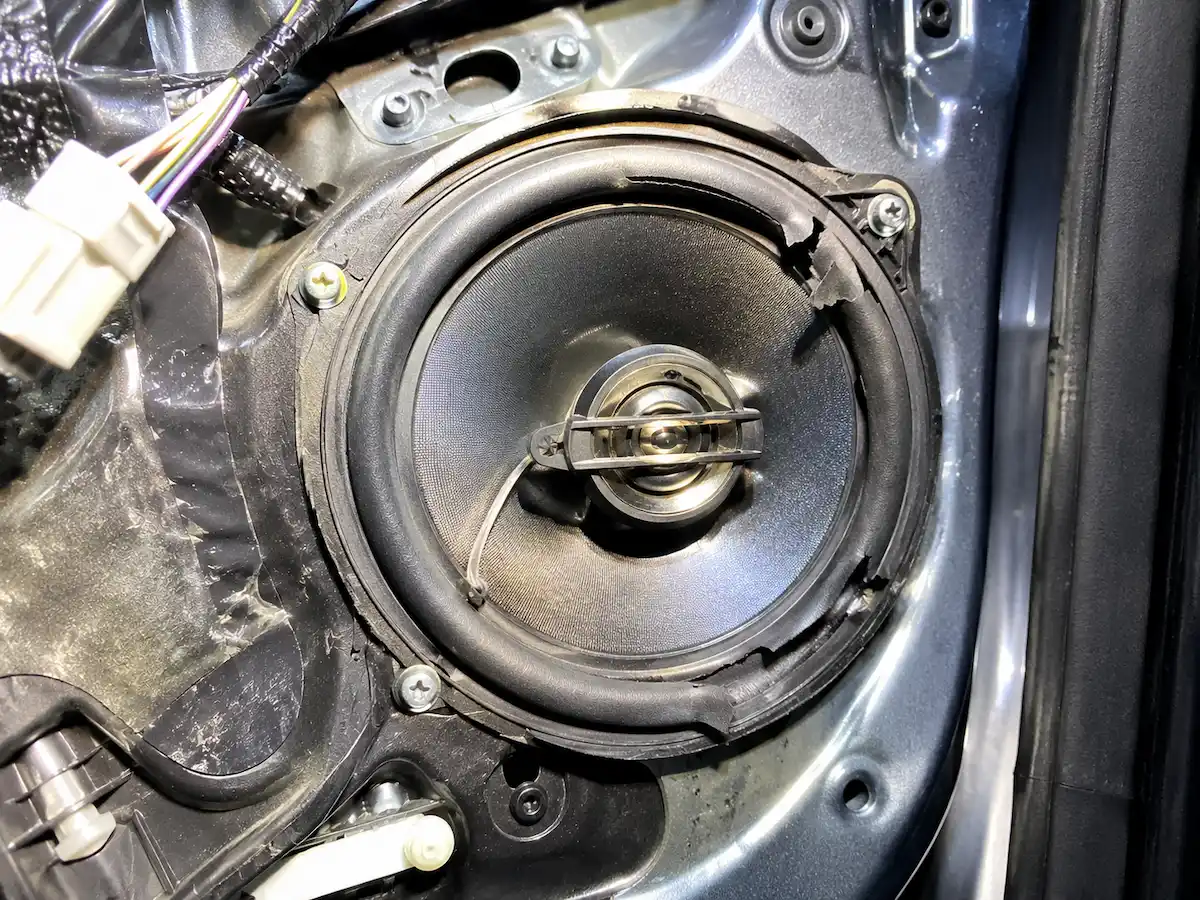
Over several years, factory foam speaker surrounds dry out, crack, and crumble away, while adhesive holding the center dust cap weakens.
When a bass note pushes the cone forward, air rushes through the torn surround gap and the loose edge flaps violently, creating a sharp crackling sound where your car speakers crackle when bass hits:
- Use your stereo’s Balance and Fader controls to isolate each speaker individually (Front Left, Front Right, Rear Left, Rear Right) while playing a 60 Hz bass test track.
- Once you pinpoint the rattling corner, pop off the door speaker grille or remove the interior door trim panel.
- Shine a flashlight around the outer flexible ring (surround) connecting the cone to the metal basket. Look for splits, tears, or sections where the glue has separated.
- Gently tap the center dome (dust cap) with your fingertip to check if the perimeter glue has lifted.
- If the surround has a small tear, you can repair it temporarily using flexible speaker repair adhesive (such as E6000 or specialized PVA surround glue). If the foam is disintegrating, replace the pair of speakers. For single-channel failures, see our guide on fixing only one car speaker working.
⚠️ Speaker Impedance Precaution: When replacing factory door speakers, verify the original speaker’s Ohm rating (printed on the magnet backplate). Many factory Bose, JBL, or Harman Kardon systems use 2-ohm speakers; installing standard 4-ohm replacements without matching impedance can halve output volume and trigger premature clipping.
RELATED AMPLIFIER GUIDE
👉 Amplifier shutting down into red protect mode on bass drops? Impedance and ground diagnosis →
Step 4: Isolate Door Panel Resonance and Loose Wiring Harnesses
Frequently, the speaker driver itself is functioning cleanly, but intense low-frequency air pressure inside the door cavity causes surrounding plastic components to vibrate against metal.
Plastic vapor barrier sheets, unclipped power window cables, loose speaker mounting screws, or degraded factory foam gaskets create a buzzing vibration that mimics blown speakers.
Damping these mechanical contact points eliminates false acoustic distortion when your car speakers crackle when bass hits:
- Play a steady bass-heavy song at moderate volume and press your hand firmly against different areas of the door panel (around the armrest, window switches, and lower map pocket).
- If the crackling stops the moment you apply hand pressure to the plastic trim, the issue is panel resonance rather than a blown voice coil.
- Tighten all four mounting screws securing the speaker frame to the door sheet metal or plastic adapter ring.
- Install a strip of closed-cell foam weatherstripping or a silicone speaker baffle gasket between the speaker mounting flange and the door frame to create an airtight acoustic seal.
- Wrap loose wiring harnesses inside the door panel with Tesa cloth tape so cables cannot slap against the inner door skin during bass hits.
Sealing air leaks and securing loose door hardware stops mechanical buzzing from causing an issue where your car speakers crackle when bass hits inside the cabin.
RELATED NOISE FIX
👉 Hearing high-pitched alternator whine that rises with engine RPM? Ground loop repair guide →
Step 5: Check Speaker Terminal Phase and Corroded Spade Connectors
Inside the bottom of car doors, rainwater drains past the window sweeps directly over the speaker basket and terminal connections.
Over time, green copper corrosion builds up on the positive (+) and negative (-) spade terminals, or the friction-fit clips loosen from door slamming.
When heavy bass excursions vibrate the speaker frame, a loose terminal arcs microscopically, producing sharp static bursts and causing your car speakers crackle when bass hits:
- Unplug the positive and negative speaker wire connectors from the speaker tabs.
- Inspect both metal terminals for white or green oxidation crust. Clean the metal contacts thoroughly using electrical contact cleaner and a small brass wire brush.
- Gently crimp the female spade connector with needle-nose pliers so it slides onto the speaker terminal with tight, high-tension grip.
- Verify speaker polarity (+ to + and – to -) across left and right doors. If one door speaker is wired out of phase, bass waves cancel each other out, forcing you to turn the volume up excessively until the speakers distort.
- If your car stereo also drops Bluetooth audio quality during streaming, check our workshop walkthrough on fixing Android Auto audio cutting out.
Resolving a frustrating car speakers crackle when bass hits problem comes down to protecting small door drivers from sub-bass overload and clean power clipping.
Setting an 80 Hz high-pass crossover filter, flattening +12 dB bass boost EQ curves, inspecting speaker surrounds for dry-rot tears, damping loose door panel clips with foam gaskets, and tightening corroded spade terminals will systematically restore crystal-clear mid-bass punch.
Follow these workshop steps whenever low-end drops distort your cabin audio, ensuring you eliminate any car speakers crackle when bass hits errors permanently.
Frequently Asked Questions (FAQ)
Why do my car speakers crackle when bass hits even on brand new speakers?
Brand new car speakers crackle when bass hits if they are receiving unfiltered sub-bass frequencies below 60 Hz without a High-Pass Filter (HPF) enabled, or if your head unit/amplifier is clipping due to maxed-out Bass Boost EQ settings.
What should I set my High-Pass Filter (HPF) to stop door speaker bass distortion?
For standard 6.5-inch door speakers, set your High-Pass Filter (HPF) to 80 Hz with a 12 dB or 24 dB slope. For smaller 4-inch or 5.25-inch speakers, set the HPF to 100 Hz so deep bass frequencies are blocked from over-extending the speaker cones.
How can I tell if my speaker is blown or if my door panel is just rattling?
Play a steady bass track and press your hand firmly against the plastic door trim around the speaker. If the rattling stops when you apply pressure, the door panel is vibrating. If the crackling persists or you hear a gritty scraping sound when gently pushing the speaker cone with the stereo off, the speaker voice coil or surround is damaged.