
Car Stereo Turns Off When Volume Is High? (Top 5 Workshop Fixes)
Does your car stereo turns off when volume is high or when deep bass hits? Discover how 12V B+ voltage drops, weak chassis grounding, and 2-Ohm speaker thermal overload trigger head unit reboot cycles, and how to solve them permanently.

Observing an abrupt shutdown where your car stereo turns off when volume is high—rebooting the exact millisecond a heavy bass drop hits or powering down after minutes of loud playback—exposes an electrical supply failure rather than a destroyed touchscreen or blown audio processor.
Modern automotive head units house integrated power amplifier integrated circuits (such as the TDA7851 or TDA7388).
These audio output stages pull between 10 and 15 amperes of dynamic electrical current when driven toward maximum gain.
If the electrical delivery path between the vehicle battery and the radio chassis cannot supply this burst current without resistance, the input rail collapses.
Under standard ISO 10487 automotive head unit power standards, head units require stable operating current.
The moment the operating rail sags below the critical 10.5-volt threshold, the internal Microcontroller Unit (MCU) triggers an emergency shutdown.
This automated brownout reset protects flash memory registers from data corruption, causing the entire head unit to reboot.
Before assuming your stereo is broken or scheduling costly dealership bench diagnostics, fifteen minutes of structured electrical testing will isolate the exact point of voltage loss.
Here are five practical workshop steps to resolve why a car stereo turns off when volume is high and enjoy distortion-free sound at high volume levels.
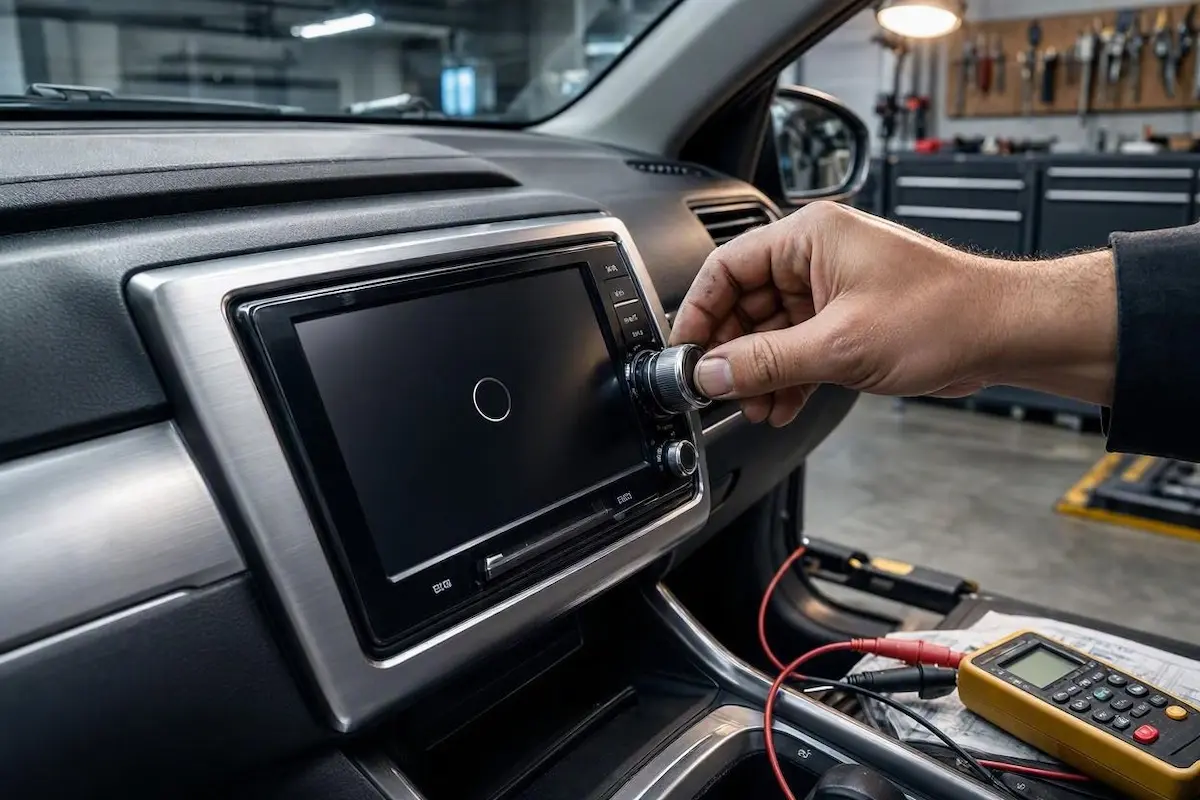
Diagnostic Matrix: Why Your Car Stereo Turns Off When Volume Is High
Match your specific vehicle symptoms against our workshop failure matrix to isolate why your car stereo turns off when volume is high before pulling dashboard panels or running auxiliary cables:
| Observed Shutdown Behavior | Underlying Electrical Root Cause | Immediate Workshop Action |
|---|---|---|
| Stereo resets instantly on heavy bass notes | Severe voltage sag below 10.5V on Yellow (+12V Constant B+) wire. | Run a dedicated 14-AWG fused power line directly to the battery positive terminal. |
| Screen flickers, speakers pop, then display dies | High electrical resistance on chassis ground return path. | Relocate Black ground wire to bare firewall metal using a star washer. |
| Plays for 3 to 5 minutes, then cuts power completely | Thermal overload caused by low-impedance 2-Ohm factory speakers. | Install 4-Ohm aftermarket speakers or add a dedicated external amplifier. |
| Unit shuts off immediately above a specific volume number | Speaker voice coil terminal shorting to bare inner door metal over bumps. | Inspect door speaker spade terminals and insulate with heat-shrink tubing. |
| Head unit restarts alongside dimming dashboard headlights | Failing vehicle alternator diode or depleted car battery reserve capacity. | Load-test car battery and check alternator charging voltage under full load. |
Step 1: Fix Voltage Sag on the Yellow (+12V Constant B+) Wire
The primary electrical trigger behind why a car stereo turns off when volume is high is voltage sag across the primary power supply wire.
Modern factory vehicle harnesses are engineered for low-power OEM radios that draw only 2 to 3 amperes.
As a result, factory wiring looms frequently use thin 20-AWG or 22-AWG copper wires.
When an aftermarket touchscreen demands 12 to 15 amperes during heavy bass transients, thin wire gauge introduces massive electrical resistance.
This current choke drops terminal voltage right at the radio plug, forcing the system into emergency protection shutdown:
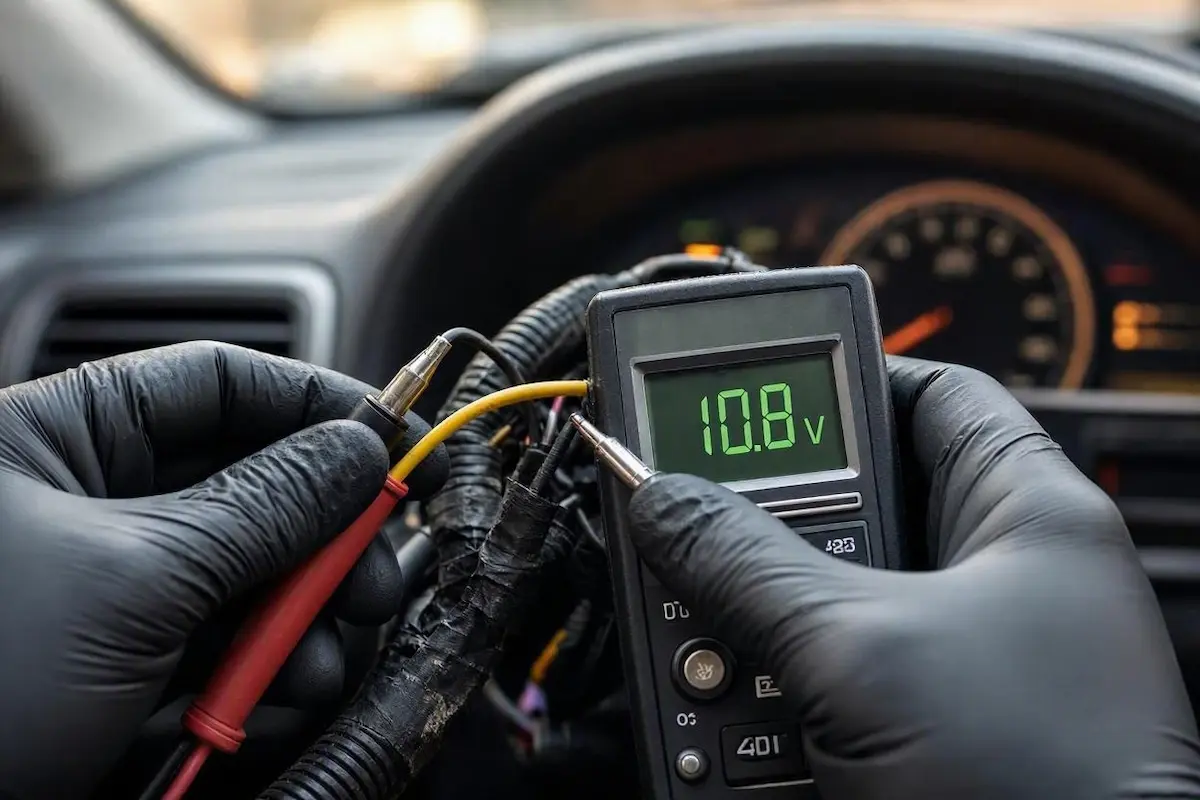
- Set a digital multimeter to DC Volts (20V range).
- Backprobe the Yellow wire (+12V Constant B+) and Black wire (Ground) at the rear of the radio harness while the car stereo is playing. Check our harness guide to connect factory wiring to android head unit looms to confirm pinouts.
- Gradually raise the volume while playing a bass-heavy music track.
- Observe the multimeter readout. If the reading drops from 12.6V down below 10.5V at the moment the unit reboots, the factory wire cannot deliver adequate current.
- The Workshop Solution: Run a dedicated 14-AWG copper wire from the vehicle’s positive battery terminal, through an inline 15A fuse located within 12 inches of the battery, straight to the yellow wire of the head unit harness.
In our workshop experience, resolving this voltage drop permanently cures cases where a car stereo turns off when volume is high across older vehicles.
⚠️ Red ACC Wire Clarification: The Red wire on your radio harness is merely an accessory turn-on trigger pulling less than 0.2A. All operating current passes through the Yellow (+12V Battery Constant) wire. Never connect high-draw power leads to the Red ignition wire, as doing so can overload vehicle ignition switch contacts.
Step 2: Upgrade the Chassis Ground to Bare Metal
An electrical circuit requires an equal and unimpeded return path to the negative battery terminal.
In our workshop experience, poor grounding is responsible for half of all volume-related audio cutouts.
Most aftermarket wiring harness adapters ground the stereo through the vehicle’s factory wiring harness.
These factory ground wires are often shared with blower motors and wiper switches, or they ground into painted dashboard framing.
When high-volume current spikes hit, ground potential floats upward, cutting off current flow and creating an issue where your car stereo turns off when volume is high:
- Snip the Black ground wire from the factory radio harness adapter coupler.
- Solder or crimp an extension using a heavy-duty 14-AWG copper wire, keeping the lead under 18 inches in length.
- Crimp a heavy-duty 8mm copper ring terminal onto the end of the wire.
- Locate a solid structural steel brace or vehicle firewall bolt beneath the dashboard.
- Use a wire brush or sandpaper to scrape away all automotive paint, primer, and rust until shiny bare metal is exposed.
- Bolt the ring terminal down tightly using a serrated star washer to bite into the metal chassis, creating an ultra-low resistance ground path (under 0.2 Ohms).
Securing this solid ground path prevents ground potential floating, ensuring your car stereo turns off when volume is high problem does not recur on uneven roads.
RELATED TROUBLESHOOTING GUIDE
Step 3: Check Speaker Impedance (The 2-Ohm Overload Trap)
Speaker impedance mismatch is the leading reason a car stereo turns off when volume is high after an audio upgrade in vehicles equipped with factory premium sound systems.
Most aftermarket touchscreen radios are engineered with Bridge-Tied Load (BTL) amplifier chips rated strictly for 4-Ohm speaker loads.
However, factory premium sound systems (such as Bose, JBL, Infinity, or Harman Kardon) frequently utilize low speaker nominal impedance drivers (2-Ohm or even 1-Ohm) to extract extra volume from low-voltage factory amplifiers.
According to Ohm’s Law ($I = V / R$), halving speaker resistance from 4 Ohms to 2 Ohms doubles current draw through the internal amplifier IC.
When you crank the volume knob, the amplifier chip overheats rapidly, tripping thermal protection registers:
- Measure DC Resistance: Unplug the speaker harness from the back of the stereo. Set your digital multimeter to Ohms (Ω). Touch the probes to the positive and negative terminals of each speaker pair (e.g., White and White/Black for Front Left).
- Analyze the Reading: A standard 4-Ohm speaker will measure between 3.2 and 3.8 Ohms of DC resistance. If your meter reads around 1.6 to 2.0 Ohms, your speakers are overloading the head unit’s internal amplifier.
- The Workshop Fix: If you face 2-Ohm speakers, you must either replace the door speakers with standard 4-Ohm aftermarket drivers or install a dedicated 4-channel external amplifier capable of driving 2-Ohm loads safely. If your speakers are completely silent, check our guide on fixing Android car stereo no sound issues.
Step 4: Inspect Door Speaker Terminals for Vibration Ground Shorts
High-volume sound waves create intense mechanical pressure and vibration inside hollow vehicle door cavities.
Mechanical shorts can make it seem like your car stereo turns off when volume is high due to defective electronics when the fault is purely physical.
When aftermarket speakers are installed in shallow door openings, the uninsulated positive spade terminal can sit less than a few millimeters away from the steel inner door frame.
Under heavy bass transients, the speaker cone vibrates aggressively, causing the door sheet metal to flex:
- Remove the front and rear door trim cards to inspect speaker mounting cavities.
- Check the clearance between the rear speaker terminals and the vehicle door metal.
- Look closely for tiny black burn marks or electrical arcing spots on the metal frame behind the speaker magnet.
- The instant an energized speaker terminal touches the grounded vehicle chassis, the stereo’s sound processor detects an overcurrent short and triggers emergency protection shutdown.
- The Workshop Solution: Desolder or unclip the terminals, slide marine-grade adhesive heat-shrink tubing over both leads, shrink it tightly, and install silicone speaker baffle cups behind each basket to isolate the driver from door metal completely.
Insulating exposed terminals stops physical shorting that causes a car stereo turns off when volume is high condition whenever driving over speed bumps.
RELATED TROUBLESHOOTING GUIDE
Step 5: Verify Car Battery Health and Alternator Charging Rails
If your car’s electrical charging system is weak, it cannot sustain transient peak current demands.
Inspecting the charging system helps identify why your car stereo turns off when volume is high during evening drives with exterior lights running:
- Park the vehicle, start the engine, and let it idle.
- Connect multimeter test leads directly across the positive and negative posts of the car battery.
- A healthy automotive alternator should deliver between 13.8V and 14.4V of steady DC charging current.
- Switch on heavy electrical loads: turn on the high-beam headlights, switch the air conditioning blower fan to maximum, and turn on the rear window defroster.
- Raise the stereo volume to your normal listening level.
- If the battery terminal voltage collapses below 12.0V while the engine is running, your alternator diodes are failing or the battery has high internal resistance. If your unit is stuck cycling on reboot, check our guide to fixing an Android car stereo boot loop.
FACTORY CONFIGURATION RESOURCE
👉 Need to adjust internal amplifier gain in Factory Settings? Access our master password directory →
Diagnosing an audio system shutdown comes down to isolating electrical starvation from thermal overload.
Running a dedicated 14-AWG fused power wire from the battery, establishing a clean bare-metal chassis ground, and verifying 4-Ohm speaker impedance permanently eliminates audio cutouts.
Following this structured electrical sequence ensures your car stereo turns off when volume is high issue is eliminated permanently, allowing you to enjoy clean, powerful sound without dashboard restarts.
Frequently Asked Questions (FAQ)
Why does my car stereo reset when the bass hits?
Low-frequency bass notes require sudden bursts of electrical current. If your stereo’s Yellow 12V constant power wire is too thin or the chassis ground has high resistance, current demand causes the supply voltage to sag below 10.5V. This voltage drop triggers an automatic microprocessor brownout reset, causing a situation where a car stereo turns off when volume is high.
Can a blown fuse cause volume-related stereo shutdowns?
No. A blown fuse results in permanent power loss until replaced. If the car stereo turns back on immediately after cutting out, the issue is an internal thermal protection trip or a low-voltage reboot caused by electrical resistance.
Will adding an external amplifier prevent high-volume stereo shutdowns?
Yes. Installing an external 4-channel amplifier takes the heavy speaker current demand off the head unit’s internal amplifier chip. If your car stereo turns off when volume is high, an amplifier allows the head unit to draw less than 2 amperes, completely preventing low-voltage reboots.
Can 2-Ohm factory speakers damage an aftermarket car stereo?
Yes. Aftermarket stereos are designed for 4-Ohm loads. Connecting 2-Ohm factory speakers doubles the electrical current flowing through the head unit’s internal amplifier IC, causing rapid overheating and triggering thermal protection shutdowns within minutes of loud playback.