
Car Amplifier Stays On When Car Is Off: 5 Best Workshop Fixes
Fix an aftermarket car amplifier that remains powered on with the ignition key turned off by diagnosing remote turn-on line shorts, auto-sense DC offset switches, and stuck relays.

Stepping out of your parked vehicle, locking the doors, and glancing into your trunk only to realize your car amplifier stays on when car is off means your vehicle starter battery is silently draining toward total failure.
Your ignition key rests in your pocket, the dashboard touchscreen is completely dark, yet the amplifier’s blue or green power LED remains stubbornly illuminated.
In professional 12-volt car audio diagnostics, an amplifier refusing to power down rarely indicates a defective internal transformer or damaged heatsink.
Common causes typically include a remote turn-on wire spliced to a permanent 12V constant battery feed, an improperly engaged high-level DC offset or audio-sense auto-turn-on switch, a shorted wire behind the dashboard, or a welded internal mechanical relay.
Because an audio amplifier draws a constant standby current of 0.5A to 1.5A when idling with its power rail active, this failure can leave your starter battery unable to crank the engine in under 24 hours, creating an urgent car amplifier stays on when car is off situation.
Before unbolting the amplifier from your trunk floor or disconnecting the main battery ground cable every night, systematic voltage testing along the remote line will pinpoint the exact trigger holding the amplifier awake.
Here are five practical workshop procedures to troubleshoot why your car amplifier stays on when car is off and restore clean, ignition-switched power management.
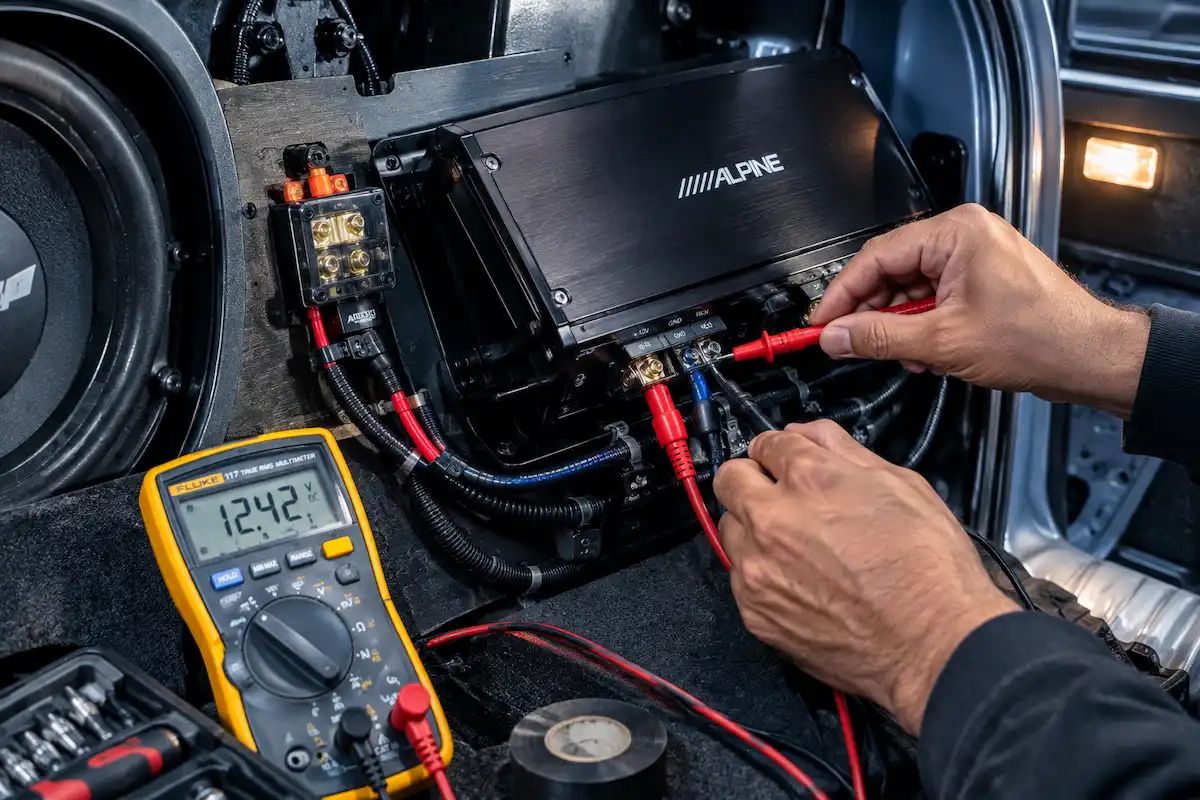
Diagnostic Matrix: Pinpointing Amplifier Standby Power Leakage
Cross-reference your amplifier’s terminal behavior against our workshop matrix whenever a car amplifier stays on when car is off problem threatens your battery:
| Observed Terminal Symptom | Underlying Electrical or Hardware Cause | Immediate Workshop Action |
|---|---|---|
| REM terminal reads +12V with vehicle key completely OFF | Remote turn-on wire spliced into permanent Yellow constant wire. | Rewire REM lead to the radio’s Blue/White wire or switched ACC fuse. |
| Amp remains powered with the physical REM wire disconnected | High-level speaker DC offset / Signal Sense switch enabled. | Switch input turn-on mode from “DC/Signal” to “REM”. |
| Amp powers down only after unplugging the RCA audio cables | Line Output Converter (LOC) back-feeding parasitic voltage down RCA ground. | Inspect LOC grounding point or isolate ground loop isolator. |
| Amp stays hot to the touch with REM reading 0.0V | Internal power rail MOSFETs shorted or mechanical relay contacts welded. | Bench test internal board for contact adhesion or replace switching relay. |
| Amp turns off 15 to 45 minutes after locking the vehicle | Connected to a delayed factory retained accessory power (RAP) circuit. | Normal vehicle body module behavior; verify final draw after 60 minutes. |
Step 1: Test Voltage on the Remote (REM) Terminal With Key OFF
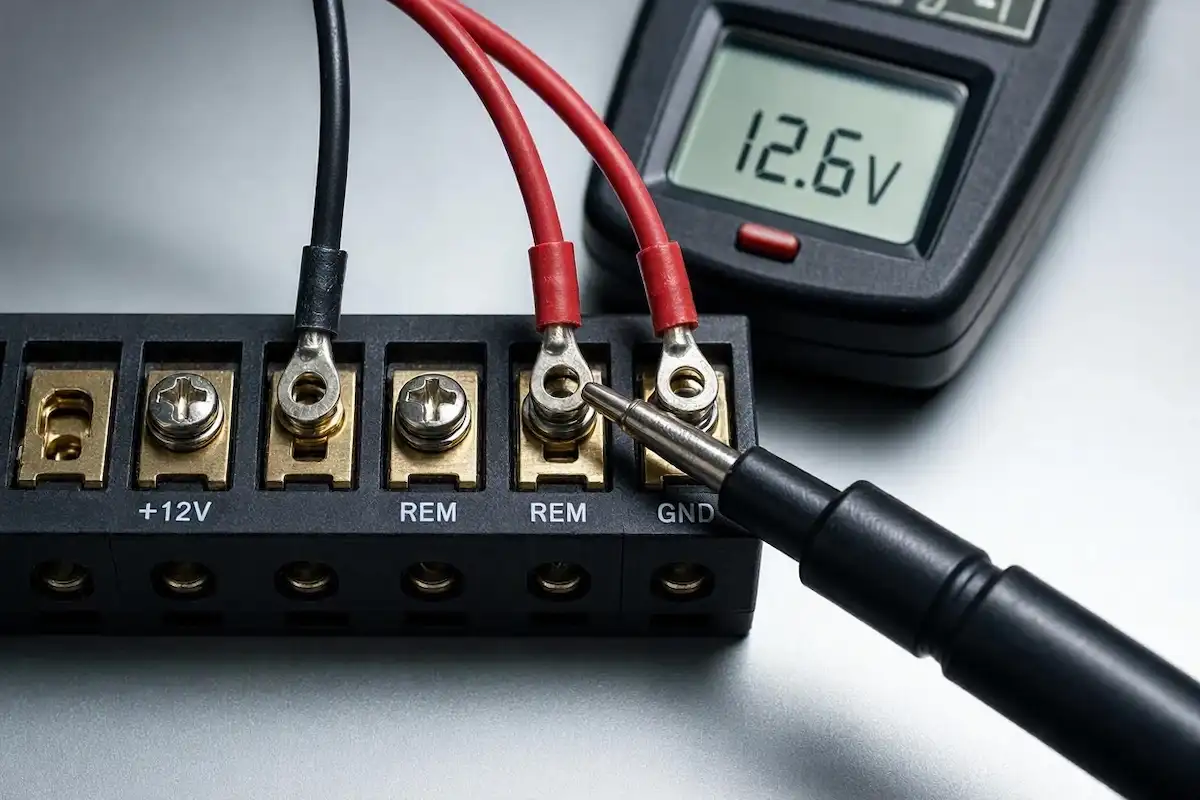
An automotive amplifier utilizes three primary terminal connections: Battery Positive (+12V), Ground (GND), and Remote Turn-On (REM).
While the +12V post stays continuously wired to the vehicle battery terminal through an inline fuse, the amplifier relies entirely on the thin REM terminal to switch its internal power supply on and off.
If an installer accidentally bridged the REM wire to the main +12V battery feed or tapped the head unit’s permanent memory wire, your car amplifier stays on when car is off indefinitely:
- Turn the vehicle ignition completely OFF and remove the key from the barrel (close all doors).
- Set your digital multimeter (DMM) to DC Volts (20V scale).
- Place the black meter probe firmly onto the amplifier’s GND terminal.
- Place the red meter probe onto the middle REM terminal screw.
- Evaluate the multimeter reading:
- If the meter reads 12.0V to 12.8V DC: The remote wire is actively receiving positive voltage from the car side. The fault is an external wiring connection error.
- If the meter reads 0.0V DC but the power light is still lit: The remote line is properly dead; proceed directly to Step 2 to check internal sensing switches.
- If the remote wire reads 12V, move the dash end of that wire from the continuous battery source to a true switched accessory line. For vehicle battery drain patterns, review our diagnostic on Android car stereo battery drain.
Whenever your car amplifier stays on when car is off, verifying that the REM screw drops to absolute zero volts ensures the amplifier receives the hardware command to shut down.
For technical reference on automotive audio current monitoring, review the Fluke Automotive Parasitic Draw Measurement Standards.
RELATED HARDWARE FIX
👉 Amplifier lights up normally but subwoofer stays completely silent? Subwoofer diagnostic guide →
Step 2: Disable High-Level DC Offset and Audio Signal Sense Modes
Many modern multi-channel amplifiers (such as models from JL Audio, Alpine, Rockford Fosgate, and Kicker) feature smart turn-on circuitry engineered for factory integration.
These settings—often labeled Turn-on Mode with options for REM / DC Offset / Audio—allow the amp to wake up without a physical remote wire by detecting micro-voltage on high-level speaker leads.
Factory car computers frequently push low-voltage diagnostic monitoring pulses across speaker lines even when the vehicle is parked, tricking the amplifier into waking up and causing a car amplifier stays on when car is off fault:
- Inspect the side control panel of your amplifier to locate the switch marked Turn-on Mode, Auto Turn-On, or Signal Sense.
- If the switch is set to DC Offset or Audio, move the toggle switch to REM.
- When set to REM mode, the amplifier completely ignores speaker wire voltage and strictly requires a dedicated +12V trigger on its REM screw terminal.
- Check if the amplifier’s power LED turns off immediately after switching modes.
- If your head unit also suffers from power drops during startup, consult our walkthrough on car stereo turns off when starting engine.
Locking the amplifier into dedicated REM control prevents vehicle telematics and background bus polling from causing an issue where your car amplifier stays on when car is off.
Step 3: Separate the Remote Wire from Factory Antenna Boost Leads
Behind the dashboard stereo harness, standard color coding designates Solid Blue for the motorized antenna trigger and Blue/White for the amplifier remote turn-on line.
While Blue/White outputs +12V whenever the stereo is awake across any audio source, a solid blue wire on some factory head units behaves erratically or stays bridged to the vehicle’s illumination or accessory line.
Furthermore, budget aftermarket harnesses can short the remote output internally, resulting in your car amplifier stays on when car is off:
- Pull out your dashboard head unit to expose the rear main wiring harness.
- Locate the wire running back to your amplifier’s REM terminal.
- Ensure it is spliced strictly to the stereo harness wire labeled AMP-CON, AMP REMOTE, or Blue/White.
- Verify that it is not twisted into the Solid Blue antenna booster wire or the Yellow permanent battery wire.
- Disconnect the remote lead from the radio harness completely. If the amplifier powers down instantly, the head unit’s internal remote switching transistor has failed shorted, requiring an alternative switched ACC fuse tap.
⚠️ Remote Wire Short Precaution: Never run an unfused remote wire directly from the vehicle battery. If a 12V remote lead pinches under carpet brackets or seat runners without fuse protection, it can overheat the wire jacket and create a dangerous vehicle electrical short.
RELATED WIRING GUIDE
👉 Wiring an aftermarket stereo harness to factory plugs? Complete color pinout walkthrough →
Step 4: Rewire Remote Line to an Add-a-Circuit Switched Fuse Tap
If your factory head unit lacks a dedicated 12V remote turn-on output, or if the radio’s internal remote circuit failed in an energized state, tapping a true switched vehicle fuse is the most reliable workshop fix.
Modern vehicle fuse panels contain circuits that drop to 0.0V the millisecond the key is switched off.
Routing the remote lead through a dedicated fuse tap permanently eliminates an car amplifier stays on when car is off dilemma without relying on complex stereo outputs:
- Locate your vehicle’s interior cabin fuse panel (commonly situated under the driver’s dashboard or behind the glove box).
- Consult the fuse diagram and identify a switched accessory circuit (such as 12V Power Outlet / Cigarette Lighter, Sunroof, or Wiper Relay). Avoid critical safety fuses like Airbags or ECU.
- Use an inexpensive Add-a-Circuit (ATM/Mini Fuse Tap).
- Insert the original vehicle fuse into the bottom slot of the tap, and insert a small 3A or 5A fuse into the top slot to protect the thin remote turn-on wire.
- Crimp your amplifier’s long remote lead to the fuse tap wire and plug it into the chosen fuse socket.
- Test operation: with the vehicle key in the OFF position, the amplifier will power down completely. If your stereo also loses time presets when parked, check our guide on fixing car stereo time and settings reset.
Using a true hardware-switched fuse tap provides a bulletproof mechanical interrupt that prevents any scenario where your car amplifier stays on when car is off.
RELATED AMPLIFIER GUIDE
👉 Amplifier shutting down into protect mode with red light? Short circuit and thermal repair guide →
Step 5: Isolate Welded Internal Relays and Line Output Converters
If you physically remove the REM wire from the amplifier terminal block, disable all auto-turn-on switches, and the power light remains illuminated, the issue originates within the hardware itself.
In older or budget amplifiers, turn-on current flows through an internal mechanical relay or solid-state MOSFET circuit.
If a severe voltage surge or low-voltage arcing occurred, relay contacts can weld themselves together, leaving your car amplifier stays on when car is off permanently:
- Unplug all RCA interconnect cables and speaker inputs from the amplifier. If the amp suddenly shuts off, a connected Line Output Converter (LOC) or digital sound processor (DSP) is back-feeding voltage through the audio shield ground.
- If the amplifier stays powered with nothing connected except the main +12V battery and GND leads (with REM completely empty), the internal switching transistor or mechanical relay is shorted closed.
- Tap the chassis of the amplifier gently with the plastic handle of a screwdriver. If a welded relay contact pops loose and the light extinguishes, the internal relay must be desoldered and replaced.
- If the unit is covered under warranty, submit it for exchange rather than disassembling the PCB board. If your system also suffers from high-volume audio dropouts, review our walkthrough on stereo sound cuts out at high volume.
Resolving a stubborn car amplifier stays on when car is off issue comes down to isolating the switching trigger from constant battery power.
Verifying 0.0V on the remote terminal screw with the key removed, switching auto-sensing modes back to dedicated REM control, confirming proper Blue/White wire splices behind the stereo, routing remote feeds through switched accessory fuse taps, and testing for back-feeding Line Output Converters ensures your sound system sleeps the moment your car does.
Follow these workshop steps whenever an amplifier refuses to power down, ensuring you eliminate any car amplifier stays on when car is off errors permanently.
Frequently Asked Questions (FAQ)
Why does my car amplifier stays on when car is off and key removed?
A car amplifier stays on when car is off issue is usually caused by the blue remote turn-on (REM) wire being spliced into a continuous +12V constant battery wire, an enabled DC Offset/Audio auto-sense switch, or an internal amplifier power relay that has welded shut.
Will an amplifier staying on kill my car battery overnight?
Yes. Even without playing music, an idle amplifier draws between 0.5A and 1.5A of standby parasitic current. This continuous electrical draw can completely deplete a healthy vehicle starter battery in 12 to 24 hours.
How do I test if my amp remote wire is bad?
Disconnect the remote wire from the amplifier’s REM terminal while the car is off. If the amplifier powers down immediately, the amplifier is healthy and the remote wire is shorted to constant 12V. If the amplifier stays on with the REM terminal empty, check for active Signal Sense switches or internal hardware faults.